
ABS vs PC vs PEEK: A CNC Machining Comparison Guide for High-Performance Plastics
When engineers select plastic materials for CNC machining, the decision is rarely based on cost alone. Mechanical strength, heat resistance, dimensional stability, machinability, and the final working environment all matter.
Among engineering plastics, ABS, PC, and PEEK are three materials often considered for machined parts. However, they are not used for the same type of applications. ABS is practical and cost-effective, PC is tough and impact-resistant, while PEEK is built for demanding industrial environments.
1. Understanding ABS, PC, and PEEK
ABS: Cost-Effective and Easy to Machine
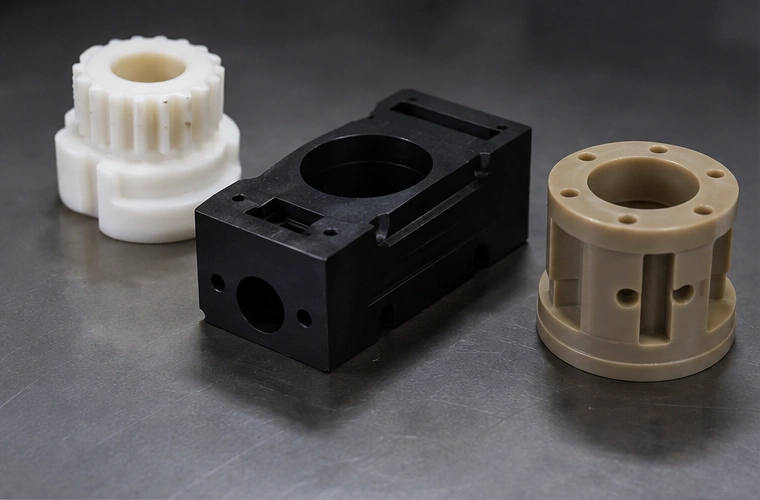
ABS is one of the most commonly used engineering plastics for CNC machining. It offers a good balance of toughness, light weight, and cost control, making it suitable for prototypes, housings, fixtures, and low-stress functional components.
Because ABS machines cleanly and does not usually cause excessive tool wear, it is often selected when the project requires fast turnaround and reasonable machining cost.
Typical applications include:
- Consumer electronic housings
- Automotive interior parts
- Prototype enclosures
- Testing fixtures
- Low-load industrial components
PC: Strong, Tough, and Impact Resistant
PC, also known as Polycarbonate, is well known for its high impact resistance. Compared with ABS, it offers better mechanical strength, better temperature resistance, and greater durability.
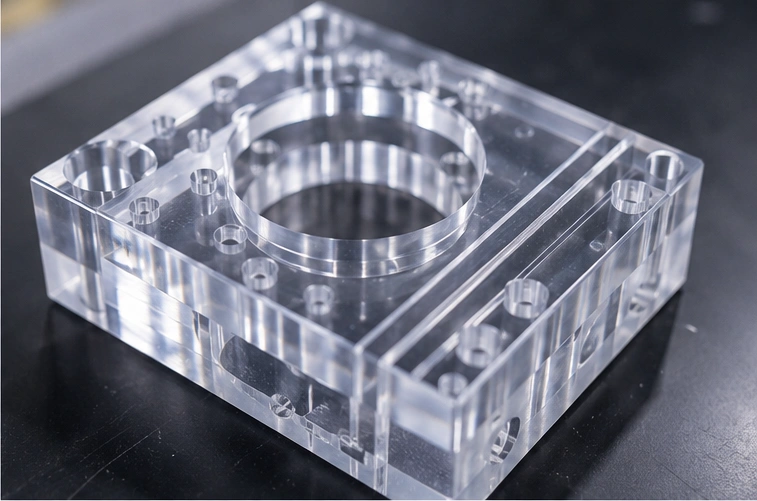
Clear PC grades are also used when transparency is required, such as protective covers or inspection windows. For CNC machining, PC needs more careful control because overheating or poor tooling can lead to burrs, stress marks, or surface damage.
Typical applications include:
- Machine guards and safety covers
- Transparent industrial components
- Medical equipment housings
- Electrical insulation parts
- Aerospace interior components
PEEK: High-Performance Plastic for Demanding Applications
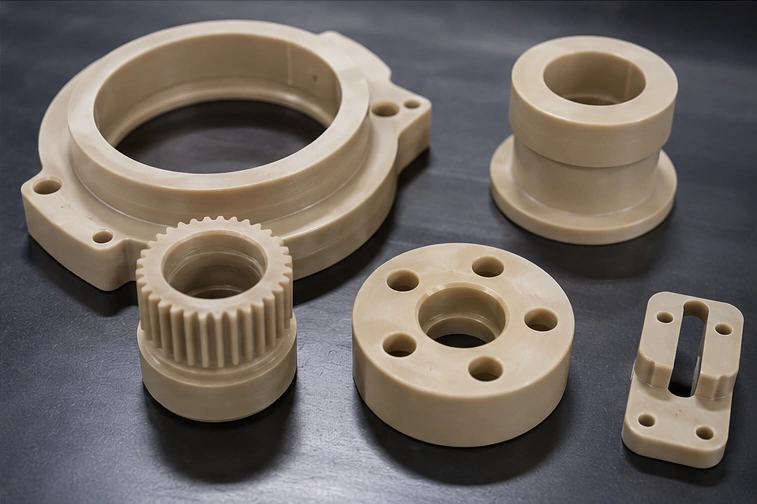
PEEK is a high-performance thermoplastic used in demanding engineering environments. It provides excellent heat resistance, chemical resistance, mechanical strength, and long-term dimensional stability.
Compared with ABS and PC, PEEK is much more expensive and more demanding to machine. However, in aerospace, medical, semiconductor, and high-temperature industrial applications, its performance often justifies the higher cost.
Typical applications include:
- Aerospace precision components
- Medical and surgical device parts
- Semiconductor equipment components
- High-temperature insulation parts
- Oil and gas sealing components
2. CNC Machining Performance Comparison
ABS Machining Performance
ABS is generally the easiest material to machine among the three. It cuts smoothly, produces stable chips, and can achieve a clean surface finish with standard plastic machining tools.
For prototype parts and general-use components, ABS is a practical choice. The main limitation is that it cannot handle high temperatures or heavy mechanical loads as well as PC or PEEK.
PC Machining Performance
PC is tougher than ABS, but that toughness also makes machining more sensitive. If cutting speed, feed rate, or tool sharpness is not properly controlled, PC may develop burrs, heat marks, or surface scratches.
For parts requiring strength, impact resistance, or transparency, PC is a strong option. It simply requires more careful machining control than ABS.
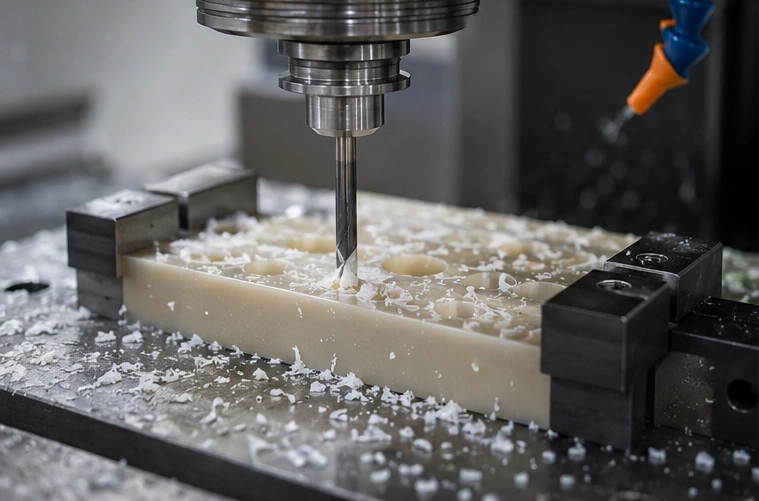
PEEK Machining Performance
PEEK offers excellent performance, but it also requires higher machining expertise. The material is strong and stable, but heat control is critical during machining. For tight tolerance PEEK parts, tool selection, cutting strategy, and stress control all become important.
PEEK is not usually selected for low-cost parts. It is selected when the part must perform reliably under heat, chemical exposure, or long-term mechanical stress.
3. ABS vs PC vs PEEK: Quick Comparison Table
| Property | ABS | PC | PEEK |
|---|---|---|---|
| Machinability | Excellent | Good | Moderate |
| Impact Resistance | Good | Excellent | Excellent |
| Heat Resistance | Moderate | Good | Excellent |
| Chemical Resistance | Moderate | Good | Excellent |
| Dimensional Stability | Good | Good | Excellent |
| Material Cost | Low | Medium | High |
| Typical Use | Prototypes, housings, fixtures | Guards, covers, durable parts | Aerospace, medical, semiconductor parts |
4. Which Plastic Should You Choose?
Choose ABS if you need:
- Cost-effective prototypes
- Fast machining turnaround
- General housings or low-load parts
- Good machinability and lower production cost
Choose PC if you need:
- High impact resistance
- Better toughness than ABS
- Transparent or protective components
- Durable parts for industrial use
Choose PEEK if you need:
- High temperature resistance
- Excellent chemical resistance
- Long-term dimensional stability
- Critical parts for aerospace, medical, or semiconductor applications
5. Final Thoughts
ABS, PC, and PEEK are all useful CNC machining plastics, but they are designed for different levels of performance.
ABS is suitable for cost-effective prototypes and general parts. PC is better for impact-resistant and durable components. PEEK is the right choice when the part must work in high-temperature, chemically aggressive, or high-performance environments.
For engineers and purchasing teams, the best material is not always the strongest or most expensive one. The right choice depends on the actual application, working environment, tolerance requirement, and budget.
Need CNC Machined Plastic Parts?
CNCTAL provides custom CNC machining services for engineering plastics including ABS, PC, PEEK, Acrylic, POM, Nylon, PTFE, and other high-performance plastic materials.
Send us your 2D drawings or 3D CAD files. Our engineering team can help review material selection, machining feasibility, surface finish, and tolerance requirements.
Upload CAD for QuoteFAQ: CNC Machining ABS, PC, and PEEK Plastic Parts
Which plastic is easiest to CNC machine, ABS, PC, or PEEK?
ABS is usually the easiest to CNC machine. It cuts cleanly, has good machinability, and is suitable for prototypes, housings, and low-stress functional parts.
Is PC better than ABS for CNC machined parts?
PC is better than ABS when the part requires higher impact resistance, better toughness, or improved temperature resistance. However, PC is usually more sensitive to heat and surface scratches during machining.
Why is PEEK more expensive to machine?
PEEK has a much higher raw material cost and requires more careful machining control. Tool selection, heat management, and tolerance planning are important when machining precision PEEK components.
Can PEEK replace metal parts?
In some applications, PEEK can replace metal parts because of its strength, heat resistance, chemical resistance, and light weight. It is often used in aerospace, medical, semiconductor, and high-temperature industrial applications.
Which plastic is best for prototype CNC machining?
ABS is often the best choice for cost-effective prototype CNC machining. If the prototype needs higher impact strength or transparency, PC may be a better option. For high-performance testing, PEEK may be selected.
Can CNCTAL machine custom plastic parts from ABS, PC, and PEEK?
Yes. CNCTAL provides custom CNC machining services for engineering plastics including ABS, PC, PEEK, Acrylic, POM, Nylon, PTFE, and other plastic materials for prototype and production projects.