
What Medical Products Can Be CNC Machined?
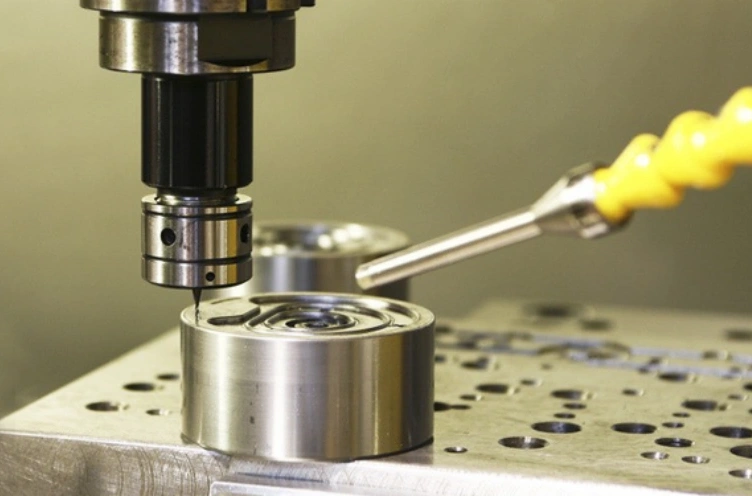
CNC machining is widely used in medical manufacturing because it can produce precision components with tight tolerances, reliable repeatability, and high-quality surface finishes for demanding medical device applications.
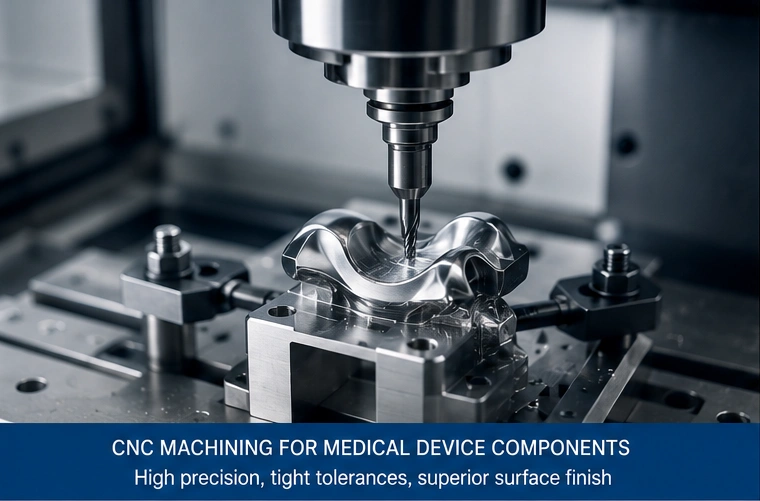
The medical industry requires high-quality and high-precision components because medical devices and healthcare products are often used in critical applications. Small dimensional errors, poor surface quality, or unstable materials may affect assembly, performance, and long-term reliability.
Because of these strict requirements, CNC machining for medical products is widely used for manufacturing implants, surgical instruments, diagnostic equipment components, endoscope parts, prosthetic components, and medical device prototypes.
Why CNC Machining Is Used in Medical Manufacturing
CNC machining is suitable for medical applications because it provides high accuracy, repeatability, material flexibility, and the ability to produce complex geometries without expensive tooling.
High Precision
Supports tight tolerances for medical device components, instruments, housings, and custom parts.
Stable Repeatability
Helps maintain consistent dimensions from prototype samples to low-volume production batches.
Material Compatibility
Works with titanium, stainless steel, aluminum, PEEK, and other medical-grade or engineering materials.
1. Medical Implants
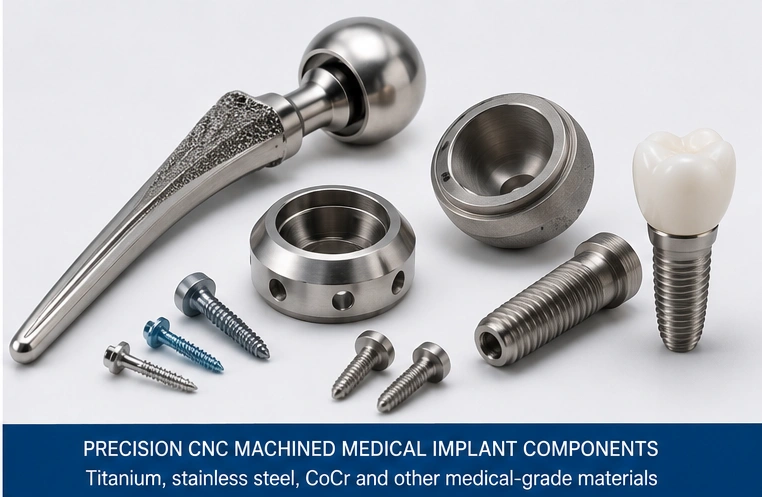
Medical implants often require extremely tight tolerances, biocompatible materials, and excellent surface quality. CNC machining is commonly used to manufacture precision implant-related components, especially when complex shapes or custom designs are required.
Orthopedic Implants
CNC machining can be used for orthopedic implant components such as hip replacement parts, knee replacement components, bone fixation plates, spinal components, and surgical screws.
These parts often use materials such as titanium alloys, stainless steel, and cobalt-chromium alloys, depending on the product design and application requirements.
Dental Implant Components
Dental applications often require customized geometries and accurate fitting. CNC machining is used for dental implant abutments, fixtures, surgical guides, and precision connectors.
2. Electronic Medical Equipment Components
Many electronic medical devices contain precision mechanical parts that require CNC machining. These parts must fit accurately with sensors, displays, cables, circuit boards, and other electronic assemblies.
MRI and Imaging Equipment Components
Certain components used in MRI systems and other medical imaging equipment can be CNC machined, including structural frames, brackets, precision housings, and mounting components.
Diagnostic Device Housings
CNC machining is also used to produce housings and enclosures for medical diagnostic equipment, monitoring devices, laboratory instruments, and electronic medical equipment.
These parts often require accurate dimensions, durable materials, smooth surfaces, and reliable integration with internal electronic components.
3. Surgical Instruments
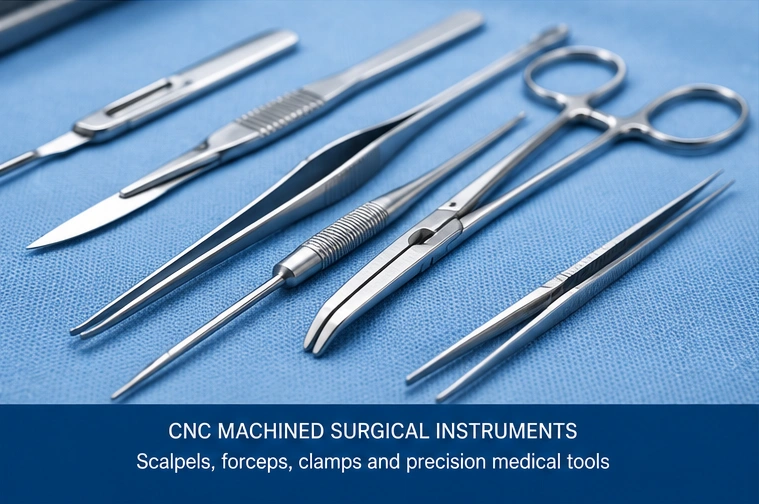
Surgical instruments often involve complex shapes, precise edges, smooth surfaces, and stable mechanical performance. CNC machining can help produce surgical tools with consistent quality and accurate geometry.
Surgical Scalpels and Blades
CNC machining can be used for surgical cutting instruments, including scalpels, blades, and precision cutting tools. These parts may require controlled edges, tight tolerances, and proper surface finishing.
Forceps, Clamps, and Custom Surgical Tools
Surgical instruments such as forceps, clamps, holders, handles, and specialized tools can also be CNC machined to achieve complex profiles and reliable mechanical function.
4. Prosthetics and Orthotic Components
CNC machining is also important for customized prosthetic and orthotic products. These components often require strength, lightweight structure, accurate fitting, and patient-specific design features.
Custom Prosthetic Components
CNC machined prosthetic components may include socket assemblies, joint mechanisms, structural connectors, lightweight supports, and custom interface parts.
Orthotic Braces and Support Devices
Orthotic components used for body support, alignment, or rehabilitation can be CNC machined from metals or engineering plastics, depending on strength, weight, and comfort requirements.
5. Endoscope Components
Endoscopic devices contain compact and precise components that require strict manufacturing control. CNC machining can be used to produce endoscope housings, connectors, structural frames, and small precision mechanical parts.
These components often need fine surface quality, compact dimensions, and reliable assembly performance.
6. Medical Device Prototypes
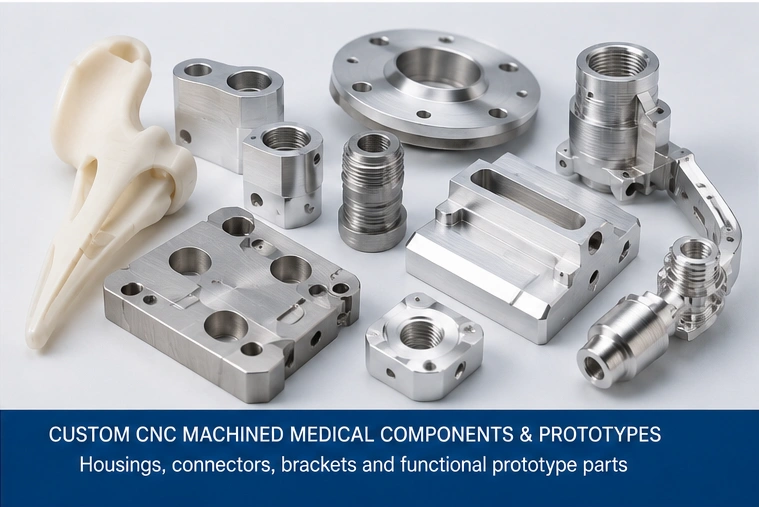
CNC machining is widely used for rapid prototyping in the medical industry. It allows engineers and product developers to test designs, validate functions, and improve manufacturability before final production.
Compared with tooling-based manufacturing methods, CNC machining provides faster design iteration and is well suited for prototype and low-volume medical device components.
Common Medical Products Made by CNC Machining
| Medical Product Category | Typical CNC Machined Parts | Key Requirements |
|---|---|---|
| Medical Implants | Orthopedic components, dental implant parts, surgical screws | Tight tolerances, biocompatible materials, high surface quality |
| Electronic Medical Devices | Housings, brackets, frames, equipment enclosures | Dimensional accuracy, durability, assembly compatibility |
| Surgical Instruments | Scalpels, forceps, clamps, holders, custom tools | Precise geometry, smooth surface finish, reliable performance |
| Prosthetics and Orthotics | Socket parts, joints, connectors, support structures | Customization, strength, lightweight design, accurate fitting |
| Endoscope Components | Housings, connectors, structural parts, small precision parts | Compact size, clean surfaces, precise assembly |
| Medical Prototypes | Functional samples, test parts, design validation components | Fast iteration, flexible design changes, low-volume production |
Common Materials for Medical CNC Machining
Material selection depends on product design, strength requirements, corrosion resistance, sterilization compatibility, weight, and application environment.
- Titanium alloys: lightweight, strong, corrosion-resistant, and widely used in medical applications.
- Medical-grade stainless steel: durable, corrosion-resistant, and suitable for instruments and components.
- Aluminum alloys: lightweight and easy to machine for housings, prototypes, and equipment parts.
- PEEK: high-performance engineering plastic used in demanding medical and industrial applications.
- Cobalt-chromium alloys: strong and wear-resistant for selected implant-related applications.
- Engineering plastics: useful for lightweight, insulating, or custom medical device components.
Important note: Medical parts may require specific material certifications, cleaning standards, surface treatments, and regulatory requirements depending on their final application. These requirements should be confirmed before production.
Final Thoughts
From medical implants and surgical instruments to diagnostic equipment, endoscope parts, prosthetic components, and medical device prototypes, CNC machining plays an important role in modern medical manufacturing.
Its ability to deliver high precision, stable repeatability, complex geometries, and material flexibility makes it a valuable manufacturing process for many medical product applications.
At CNCTAL, we provide custom CNC machining services for precision components, prototypes, low-volume production, and complex engineering parts. Our team can support CNC milling, CNC turning, 5-axis machining, and surface finishing based on your drawings and material requirements.
Need Custom CNC Machined Medical Components?
Send us your 2D drawings, 3D CAD files, material requirements, tolerance needs, and quantity details. CNCTAL can help evaluate the most suitable CNC machining solution for your medical device components.
Upload CAD for Quote