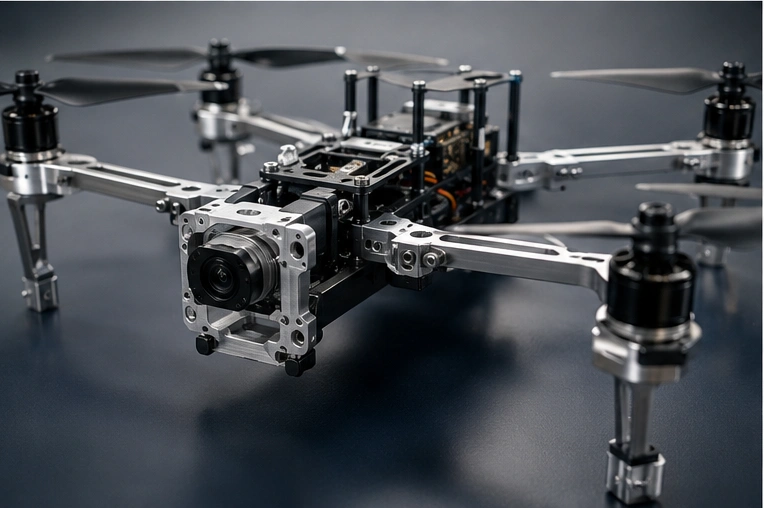

CNC Machining Motorcycle Parts: Why OEM Manufacturers and Custom Builders Rely on CNC Technology
Motorcycles are more than transportation. For many riders and manufacturers, they represent performance, engineering, reliability, and personal style. Whether it is OEM motorcycle production or custom aftermarket upgrades, CNC machining has become one of the most important manufacturing methods for producing high-quality motorcycle components.
From lightweight aluminum triple clamps to precision stainless steel brake brackets, CNC machining gives motorcycle manufacturers the accuracy, repeatability, and design freedom needed for modern motorcycle parts.
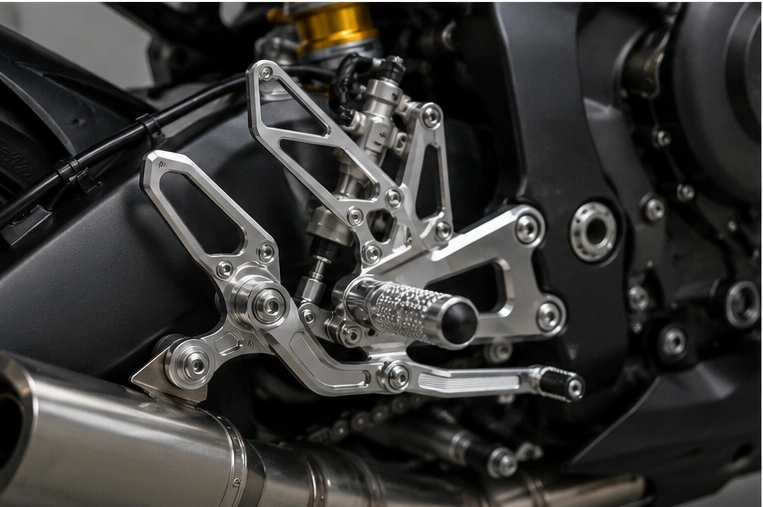
Why CNC Machining Is Popular in Motorcycle Manufacturing
Motorcycle parts often work under vibration, heat, load, and long-term outdoor conditions. Because of this, manufacturers need components with stable tolerances, reliable strength, and clean surface quality.
Compared with manual machining or low-precision manufacturing methods, CNC machining offers better consistency and repeatability. This is especially important when parts need to fit accurately with frames, engines, brake systems, suspension systems, or steering assemblies.
- High dimensional accuracy for assembly parts
- Stable repeatability for production orders
- Good surface quality after machining
- Flexible production from prototype to low-volume and mass production
- Suitable for complex shapes and lightweight structures
- Compatible with aluminum, stainless steel, brass, steel, and engineering plastics
Common CNC Machined Motorcycle Parts
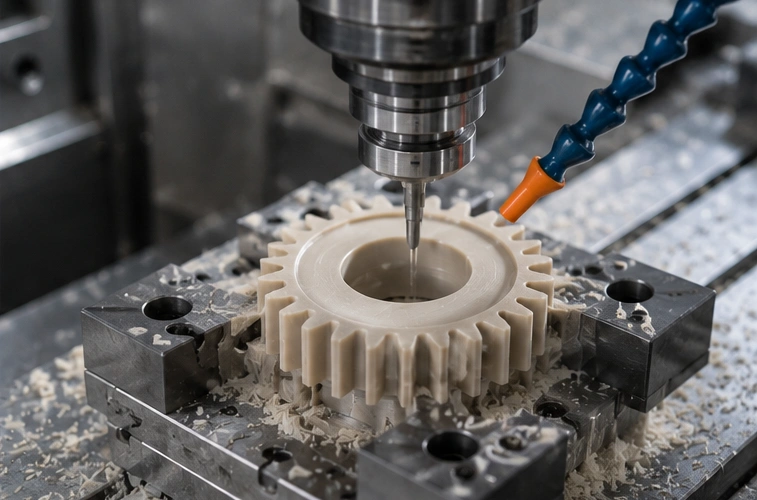
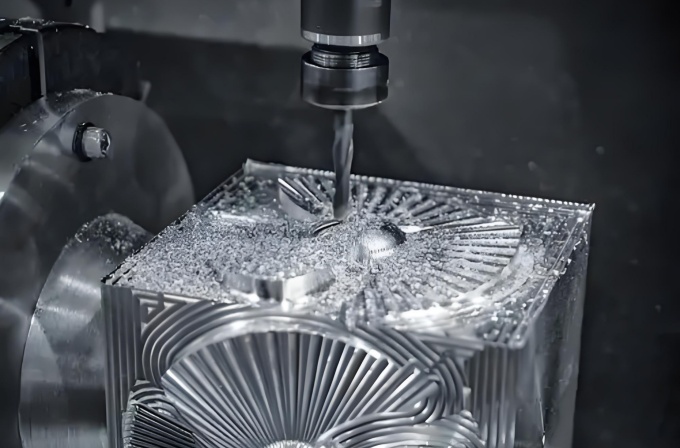
Many motorcycle components can be produced by CNC milling, CNC turning, or a combination of both processes. Some parts require simple 2.5D machining, while others need multi-axis machining for complex curves, pockets, and mounting features.
Typical CNC Motorcycle Components
- Triple clamps and handlebar risers
- Rearsets, foot pegs, and shift levers
- Brake caliper brackets and brake adapters
- Engine covers and clutch covers
- Wheel hubs, axle spacers, and bushings
- Suspension linkage components
- Steering stems and mounting brackets
- Custom dashboard mounts and sensor brackets
These parts are not only functional. Many of them are also visible on the motorcycle, so appearance matters. CNC machining can create sharp details, clean edges, and a premium machined finish that is difficult to achieve with rough casting or basic fabrication methods.
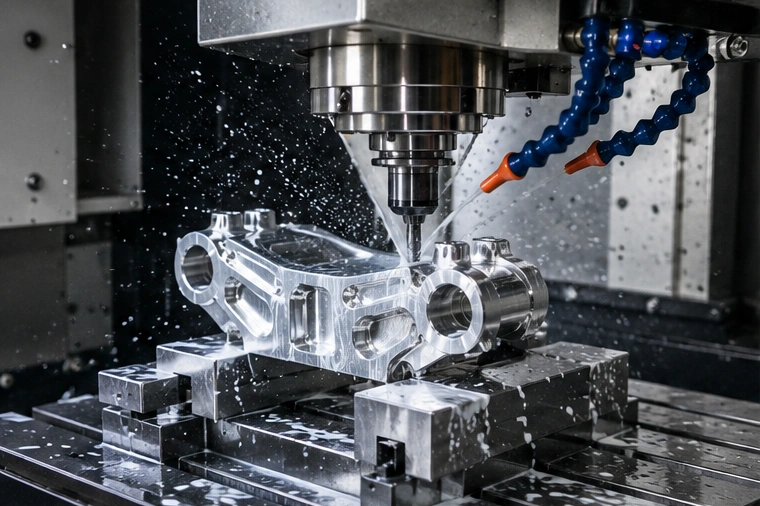
CNC Machining for Motorcycle OEM Production
For motorcycle OEM manufacturers, stable quality is extremely important. A small dimensional error can affect installation, alignment, riding stability, or long-term reliability.
CNC machining helps manufacturers maintain consistent dimensions across production batches. Once the machining program, tooling, fixtures, and inspection standards are confirmed, the same part can be produced repeatedly with controlled quality.
This makes CNC machining suitable for motorcycle parts that require accurate mounting holes, threaded features, flat surfaces, bearing seats, or tight assembly positions.
CNC Machining for Custom Motorcycle Upgrades
CNC machining is also widely used in custom motorcycle projects and aftermarket upgrade parts. Custom builders and motorcycle brands often need parts that are lighter, stronger, more attractive, or designed for a specific model.
Unlike mold-based manufacturing, CNC machining does not require expensive tooling at the early stage. This makes it very suitable for small-batch custom parts, test samples, and limited-edition motorcycle accessories.
- Custom brake levers
- Billet aluminum foot pegs
- Personalized handlebar clamps
- Lightweight sprocket carriers
- CNC clutch and engine covers
- Decorative caps and custom mounting parts
Why Aluminum Is Widely Used for Motorcycle CNC Parts
Aluminum alloys are among the most common materials for motorcycle CNC machining. Materials such as 6061 aluminum and 7075 aluminum are widely used because they provide a good balance of strength, weight, machinability, and surface finishing performance.
For motorcycle parts, weight reduction is always valuable. A lighter component can improve handling, acceleration, and overall riding feel, especially for racing motorcycles or performance upgrades.
After machining, aluminum motorcycle parts are often finished with anodizing, hard anodizing, sandblasting, polishing, or powder coating. These finishes can improve corrosion resistance and give the part a more professional appearance.
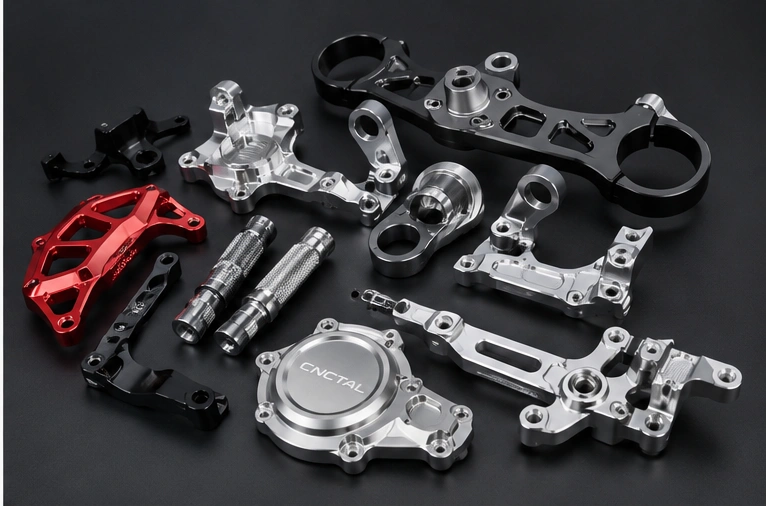
The Importance of Surface Finish in Motorcycle Parts
Motorcycle riders care about performance, but they also care about how the bike looks. This is especially true for custom motorcycles, racing motorcycles, and premium aftermarket parts.
A well-machined aluminum part with a clean surface and proper anodizing can completely change the visual character of a motorcycle. On the other hand, poor machining marks, sharp burrs, or uneven finishing can make even a good design look low quality.
Professional CNC machining should include proper deburring, edge breaking, surface inspection, and finishing control. These details are important for both appearance and safe handling during assembly.
CNC Machining Helps Speed Up Motorcycle Product Development
In motorcycle product development, speed matters. Whether a company is developing a new model, testing an upgraded bracket, or improving a custom accessory, engineers need physical parts quickly.
CNC machining allows design teams to move from CAD drawing to real metal parts without waiting for mold production. This helps shorten development cycles and makes design changes easier.
For startup motorcycle brands, racing teams, and custom workshops, this flexibility is very useful. A part can be tested, adjusted, and produced again in a short time.
Quality Control for Motorcycle CNC Components
Motorcycle components require more than good machining. They also need reliable inspection. Critical dimensions such as hole positions, threads, flatness, bearing fits, and assembly surfaces should be checked carefully.
A professional CNC machining supplier should have a clear inspection process, including dimensional inspection, thread checking, material verification, surface finish review, and final quality control before shipment.
For parts used in OEM production, batch consistency is especially important. Stable quality helps reduce assembly problems and improves the reliability of the final motorcycle.
Choosing the Right CNC Machining Partner for Motorcycle Parts
When choosing a CNC machining supplier for motorcycle components, buyers should not only compare prices. It is also important to check machining capability, engineering communication, material experience, surface finishing support, and quality control.
- Experience with aluminum and stainless steel motorcycle parts
- CNC milling and CNC turning capability
- Support for prototype, low-volume, and production orders
- Ability to handle surface finishing such as anodizing and polishing
- Clear communication for drawings, tolerances, and technical requirements
- Stable inspection process before delivery
Conclusion
From OEM motorcycle production to custom performance upgrades, CNC machining plays an important role in modern motorcycle manufacturing. It provides the accuracy, strength, repeatability, and appearance required for high-quality motorcycle components.
As motorcycle design continues to move toward lighter weight, better performance, and more personalization, CNC machining will remain one of the most reliable manufacturing choices for motorcycle parts.
Custom CNC Machining for Motorcycle Parts
CNCTAL provides custom CNC machining services for motorcycle components, including CNC milling, CNC turning, aluminum machining, stainless steel machining, and surface finishing for prototype and production projects.
Upload CAD Files for a Quote