
What Is CNC Machining?
A practical introduction to CNC machining processes, machine types, materials, tolerances, applications, and the technologies shaping modern precision manufacturing.
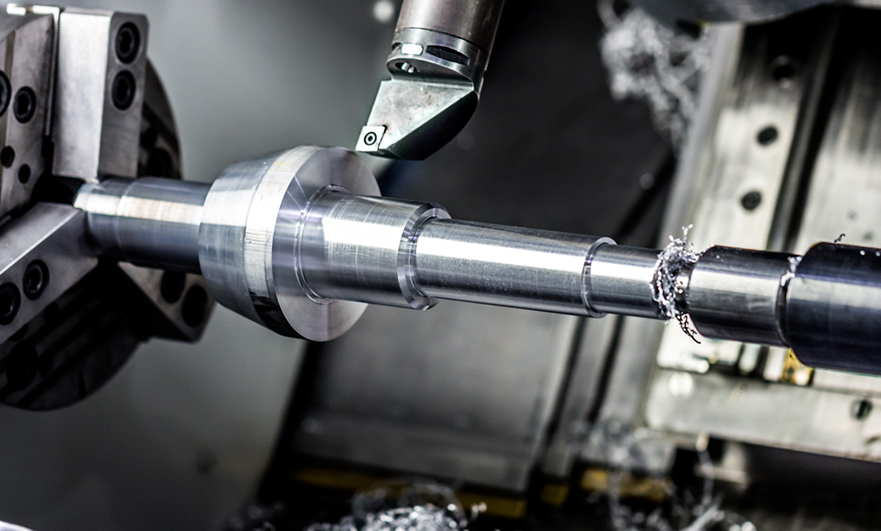
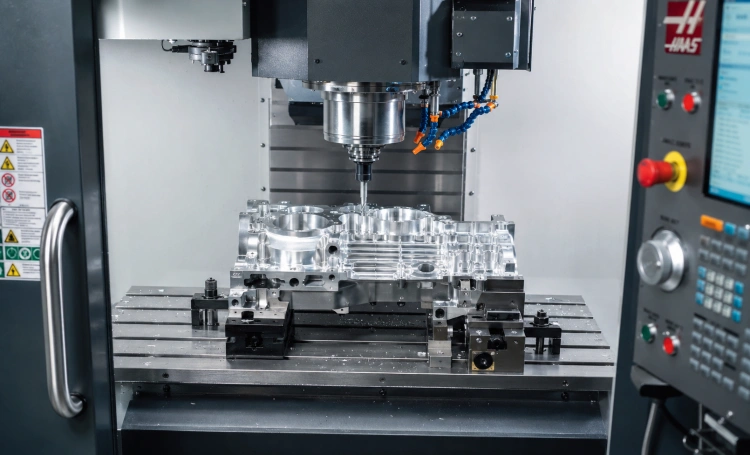
CNC machining is a manufacturing process that uses computer-controlled machine tools to remove material from a solid workpiece and produce a finished component.
The starting material may be a block, plate, bar, tube, forging, or casting. Cutting tools remove material in a controlled sequence until the required shape, holes, threads, dimensions, and surface features are produced.
What does CNC stand for?
CNC stands for Computer Numerical Control. The machine follows programmed instructions that control tool position, spindle speed, feed rate, cutting depth, tool changes, coolant delivery, and other machine functions.
CNC machining is not simply a matter of uploading a three-dimensional model and pressing a start button. Reliable machining also depends on the part design, material condition, CAM programming, workholding, cutting tools, thermal stability, inspection method, and the experience of the manufacturing team.
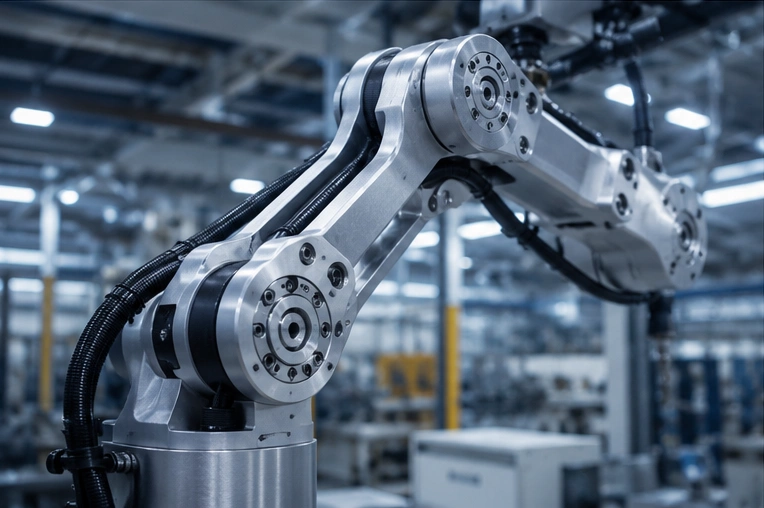
Modern CNC manufacturing combines mechanical engineering, software, tooling, machine control, measurement, and production knowledge. It is used for everything from simple spacers and shafts to robotic joints, aerospace housings, valve components, heat sinks, precision gears, and complex fluid manifolds.
How Does CNC Machining Work?
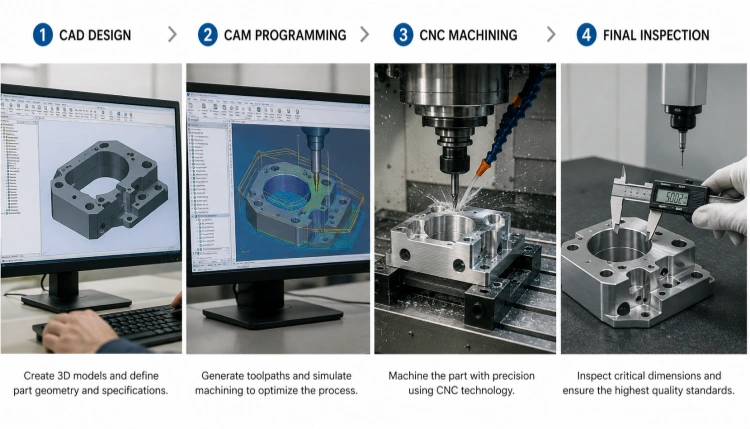
Most CNC machining projects follow a similar sequence, although the exact process changes according to the geometry, tolerance, material, and production quantity.
CAD Design
The process begins with a 3D CAD model. A two-dimensional drawing is normally added to define tolerances, threads, surface roughness, material, heat treatment, and inspection requirements.
Design for Manufacturability Review
Engineers review tool access, internal radii, wall thickness, deep pockets, clamping surfaces, tolerances, and features that may be difficult to inspect.
CAM Programming
CAM software is used to select cutting tools, create toolpaths, define cutting parameters, simulate the process, and generate machine-readable NC code.
Machine Setup and Workholding
The material is located and clamped using vises, chucks, soft jaws, fixtures, pallets, collets, or other workholding systems.
Machining Operations
The part may be faced, roughed, drilled, bored, milled, turned, threaded, finished, chamfered, and deburred in one or more setups.
Inspection and Finishing
Critical dimensions are checked during and after production. The component may then receive anodizing, plating, blasting, polishing, passivation, or another finish.
A 3D model defines nominal geometry, but it does not always communicate the functional requirements. A STEP file together with a clear PDF drawing usually provides the best basis for manufacturing and quotation.
Main Types of CNC Machining
CNC machining covers several processes. The right choice depends on the shape of the component, material, tolerance, production volume, and feature accessibility.
CNC Milling
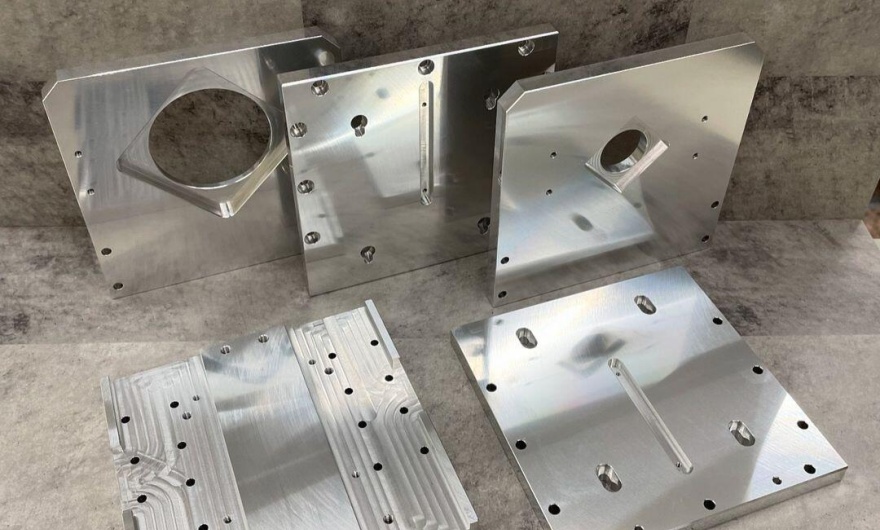
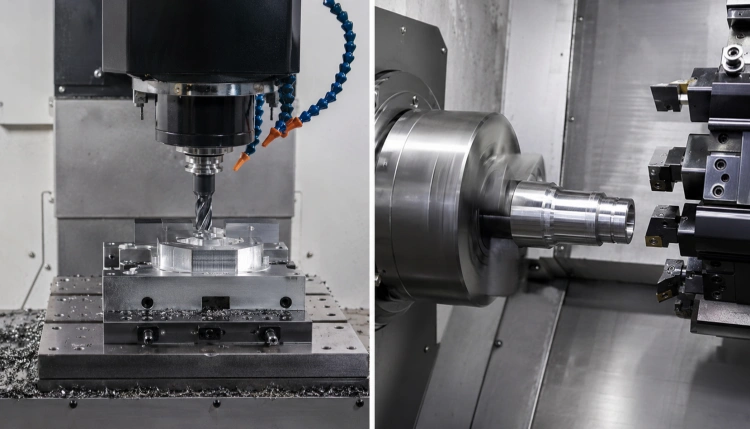
A rotating cutting tool removes material from a workpiece held on a table or fixture. Milling is widely used for housings, brackets, plates, manifolds, pockets, slots, and contoured surfaces.
CNC Turning
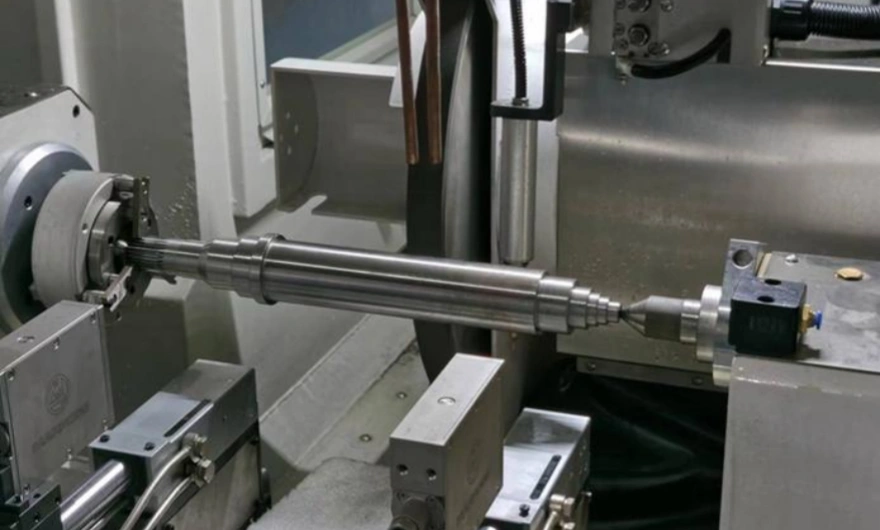
The workpiece rotates while a cutting tool moves against it. Turning is suited to shafts, bushings, pins, rollers, sleeves, nozzles, flanges, and threaded components.
Mill-Turn Machining
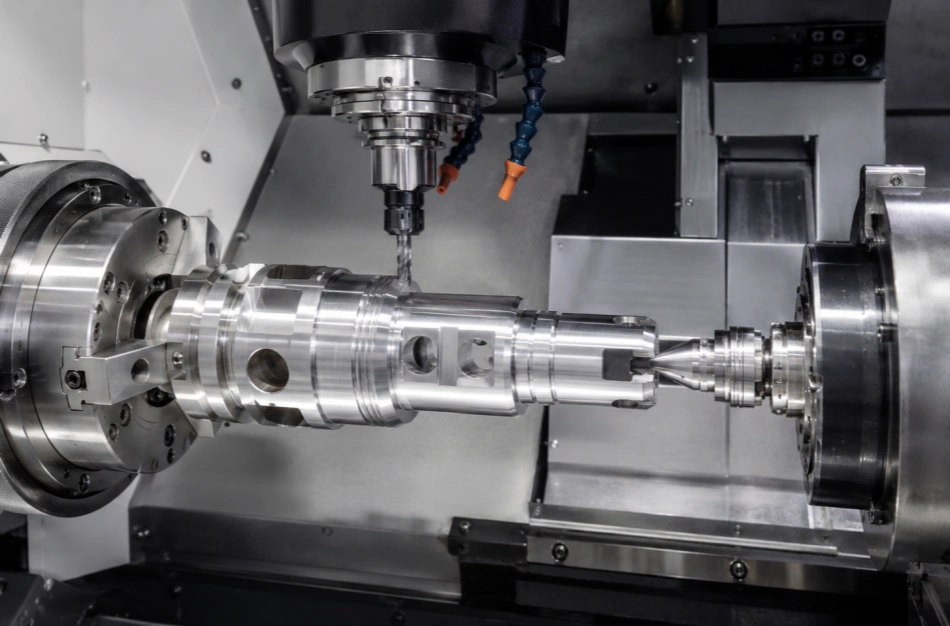
Mill-turn machines combine turning and live-tool milling. They can reduce setups for parts that contain both cylindrical and prismatic features.
Swiss-Type Machining
Swiss-type lathes support the material close to the cutting zone. They are effective for small, long, precision parts produced from bar stock.
5-Axis CNC Machining
Five-axis equipment adds two rotary axes. It can machine multiple sides, improve tool access, and support complex curved surfaces with fewer setups.
EDM Machining
Electrical discharge machining removes conductive material using controlled electrical discharges. It is useful for hardened parts, narrow slots, sharp details, and difficult internal features.
3+2 Machining vs Simultaneous 5-Axis Machining
In 3+2 machining, the rotary axes position the component at a fixed angle before a three-axis cutting operation begins. During simultaneous five-axis machining, all five axes can move together while the tool is cutting.
Simultaneous five-axis machining is valuable for impellers, complex aerospace parts, curved ports, medical components, and precision surfaces. However, a five-axis machine is not automatically the best or lowest-cost solution for every part.
What Materials Can Be CNC Machined?
CNC machining can produce components from a wide range of metals and engineering plastics. Each material behaves differently under cutting forces, heat, clamping pressure, and surface-finishing processes.
Aluminum
6061, 7075, 6082, 5052, 2024 and 5083 are common choices for housings, fixtures and lightweight structural parts.
Stainless Steel
303, 304, 316 and 17-4 PH provide different combinations of corrosion resistance, strength, machinability and hardness.
Carbon and Alloy Steel
Mild steel, 1045, 4140, 42CrMo4 and tool steels are used for shafts, fixtures, mechanical parts, molds and wear components.
Brass, Bronze and Copper
These materials are used for fittings, electrical components, bushings, heat-transfer parts and precision instruments.
Titanium
Titanium offers high strength-to-weight ratio and corrosion resistance, but requires controlled tooling, coolant and cutting engagement.
Engineering Plastics
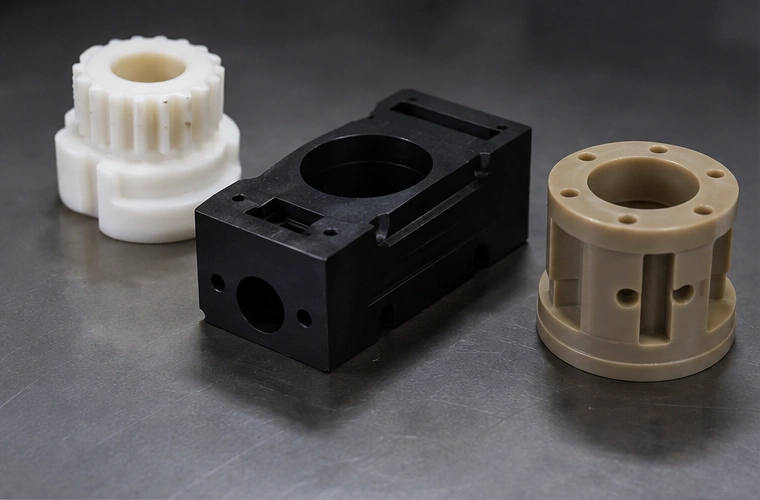
POM, nylon, PEEK, PTFE, PMMA, ABS, polycarbonate and UHMW-PE are commonly CNC machined for mechanical and insulating components.
Engineering plastics may deform because of heat, internal stress, moisture absorption, and clamping pressure. A machining method suitable for aluminum may not be suitable for a thin POM, nylon, or PTFE part.
CNC Machining Accuracy and Tolerances
There is no single tolerance that applies to every CNC-machined component. Achievable accuracy depends on part size, geometry, material, wall thickness, tool reach, fixture stability, machine condition, temperature, and inspection method.
A general tolerance such as ±0.10 mm may be practical for many non-critical dimensions. A tolerance of ±0.01 mm can also be achieved on suitable features under controlled conditions, but it should not automatically be applied across an entire drawing.
| Tolerance Requirement | Typical Manufacturing Considerations |
|---|---|
| General dimensions | Standard tools, conventional finishing, and normal inspection methods may be sufficient. |
| Critical ±0.01 mm features | Stable workholding, finishing allowance, temperature control, tool compensation, and more frequent inspection may be required. |
| Precision bores and fits | Boring, reaming, honing, grinding, or dedicated gauges may be required depending on the fit and diameter. |
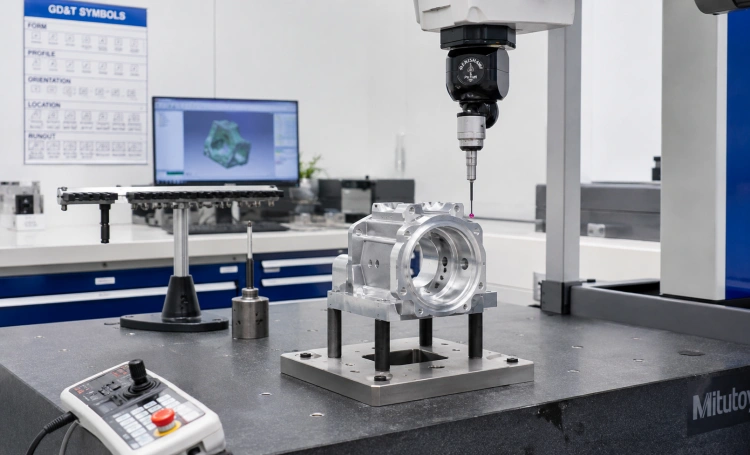
| Geometric tolerances | Datum strategy, setup planning, CMM access, and feature relationships become especially important. |
Machine positioning accuracy is only one part of finished part accuracy. Tool deflection, cutter wear, thermal growth, material stress, workpiece movement, and measurement technique can all influence the final result.
Tight tolerances should therefore be applied to dimensions that affect fit, sealing, alignment, movement, function, or assembly. Unnecessary tolerances increase machining and inspection cost without necessarily improving performance.
Common Surface Finishes for CNC Parts
A CNC-machined part can be supplied as machined or sent for additional surface treatment.
As Machined
The part retains the natural machining pattern. Sharp edges are normally deburred unless otherwise specified.
Bead Blasting
Produces a more uniform matte appearance and can reduce visible directional machining marks.
Anodizing
Commonly applied to aluminum for corrosion resistance, wear performance, and decorative color.
Electroplating
Zinc, nickel, chrome, and other coatings can improve corrosion resistance, appearance, or electrical properties.
Passivation
Used mainly for stainless steel to improve the condition of the corrosion-resistant passive surface.
Polishing and Brushing
Used when surface appearance, reflectivity, or a directional cosmetic texture is important.
Surface treatment should be considered before machining is finalized because some coatings add thickness while others alter or remove a small amount of material.
Precision bores, bearing fits, threads, sealing surfaces, and electrical contact areas may need masking.
Advantages and Limitations of CNC Machining
Main Advantages
- Accurate production of critical dimensions and feature relationships.
- Suitable for prototypes, low-volume production, and repeat production.
- Wide selection of engineering metals and plastics.
- No injection mold or dedicated die is required for most projects.
- Design changes can often be introduced by updating the CAD model and program.
- Threads, sealing faces, pockets, holes, and complex surfaces can be combined.
Main Limitations
- Material is removed, so parts with heavy stock removal may generate significant waste.
- A cutting tool must physically reach the feature being machined.
- Sharp internal corners cannot normally be made with a standard rotating cutter.
- Complex parts may require multiple setups and special fixtures.
- Injection molding, casting, forging, stamping, or extrusion may be more economical at high volumes.
- Deep pockets, thin walls, long-reach tools, and tight tolerances increase process risk and cost.
How Modern CNC Machining Is Changing
The fundamental principle of CNC machining remains the same: controlled machine motion removes material. What has changed is how the process is programmed, simulated, measured, automated, and monitored.
Advanced Machine Simulation
Modern CAM systems can simulate the actual machine environment, including rotary tables, spindles, toolholders, fixtures, travel limits, and machine kinematics.
This is particularly important for five-axis and mill-turn programs, where the toolpath may appear correct on the CAD model but still create a collision at machine level.
Digital Twin Technology
A machine digital twin can represent the physical machine, axis movement, control behavior, tooling, and workholding. It allows engineers to evaluate NC programs before cutting actual material.
On-Machine Probing
Probes and tool setters can locate workpieces, establish work offsets, detect tool breakage, confirm part orientation, and measure selected features without unloading the component.
On-machine measurement does not replace every final inspection requirement, but it can detect problems earlier and reduce the risk of continuing an incorrect process.
Automated Loading and Unloading
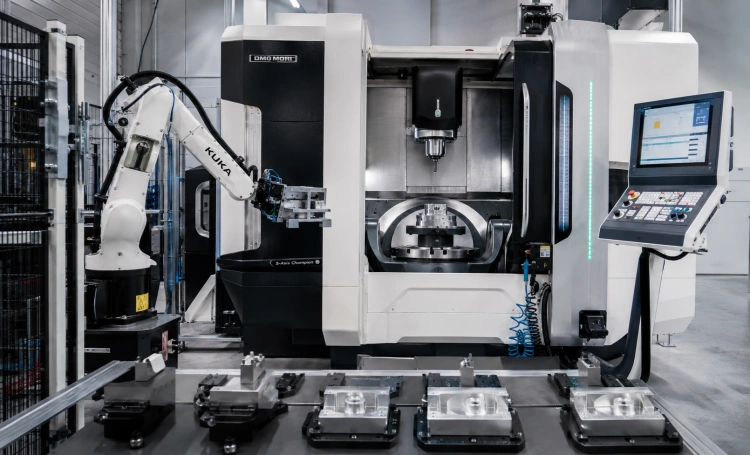
Robot arms, bar feeders, gantry loaders, pallet changers, and part-handling systems can increase machine utilization. However, automation works only when the cutting process, tool life, chip control, fixturing, and inspection method are already stable.
Connected Production Data
Modern machines can collect cycle time, spindle load, alarm history, tool usage, downtime, and program progress. Manufacturers can use this information to identify bottlenecks and improve maintenance or process planning.
AI-Assisted CAM Programming
AI-assisted tools are increasingly used for feature recognition, operation suggestions, reuse of proven machining knowledge, process planning, and inspection programming.
These systems can reduce repetitive work, but experienced engineers must still verify workholding, tool access, cutting parameters, machine limits, tolerances, and collision risks.
A robot can load a machine repeatedly, but it cannot make an unstable machining process reliable. Tool life, chip removal, fixture cleanliness, raw material consistency, and inspection still need to be controlled.
Which Industries Use CNC Machining?
Aerospace
Structural brackets, actuator parts, housings, manifolds, and precision mechanical components.
Medical Equipment
Surgical tools, diagnostic equipment parts, fixtures, housings, and precision device components.
Automation and Robotics
End effectors, grippers, joint parts, mounting plates, fixtures, sensor brackets, and linear-motion parts.
Electronics
Enclosures, heat sinks, connector bodies, RF parts, frames, and liquid-cooling components.
Automotive and Motorsport
Brackets, suspension parts, drivetrain components, adapters, housings, and prototypes.
Industrial Machinery
Shafts, fixtures, rollers, plates, gears, bearing housings, molds, and replacement parts.
How to Prepare a CNC Machining Request
A complete technical request reduces quotation delays and helps the manufacturer choose an appropriate machining process.
Provide a 3D CAD File
STEP or STP is one of the most widely accepted formats for CNC quotation, DFM review, and CAM programming.
Include a 2D Technical Drawing
The drawing should define critical tolerances, threads, datums, GD&T, surface roughness, coating requirements, and inspection criteria.
State the Exact Material Grade
Instead of writing only “aluminum” or “stainless steel,” identify grades such as Aluminum 6061-T6, Stainless Steel 304, POM-C, 42CrMo4, or Titanium Grade 5.
Provide the Required Quantity
Include prototype quantity, first production batch, and estimated annual demand when available. This helps the manufacturer evaluate whether custom fixtures, bar-fed production, or multi-part machining are justified.
Define Surface Finish and Inspection
State the required coating, color, cosmetic surfaces, masking areas, inspection report, material certificate, CMM report, or functional test.
Confirm the Target Delivery Date
The delivery target should allow time for raw material, machining, outside finishing, inspection, packaging, and international transportation.
Frequently Asked Questions
Is CNC machining the same as 3D printing?
No. CNC machining removes material from solid stock, while 3D printing builds a part layer by layer. Each process has different advantages, materials, tolerances, and geometry limitations.
What is the difference between CNC milling and turning?
CNC milling normally rotates the cutting tool while holding the workpiece. CNC turning rotates the workpiece while the cutting tool moves against it.
Can CNC machines hold ±0.01 mm tolerances?
Suitable CNC equipment can hold ±0.01 mm on appropriate features under controlled conditions. However, this should not be assumed for every dimension, material, geometry, or part size.
Does a five-axis machine always make a better part?
No. Five-axis machining is valuable for complex surfaces, angled features, and reducing setups. A three-axis mill or CNC lathe may be more efficient for simpler components.
Why does CNC machining cost vary so much?
Cost depends on material, stock size, setup time, machining time, tool access, tolerance, number of setups, surface treatment, inspection, and quantity.
What file format is best for a CNC quote?
A STEP file together with a PDF technical drawing is normally the most useful combination. The STEP file provides geometry, while the drawing defines manufacturing and inspection requirements.
Conclusion
CNC machining is a computer-controlled manufacturing process, but a reliable finished component depends on much more than machine movement.
Good results require a suitable material, practical tolerances, stable workholding, correct cutting tools, controlled machining parameters, and an inspection plan that focuses on functional features.
Modern CNC manufacturing now combines multi-axis equipment, mill-turn machines, adaptive CAM toolpaths, digital simulation, probing, automated handling, connected production data, and AI-assisted software.
Even with these technologies, the basic manufacturing principles remain unchanged: understand the part, control the process, and measure the features that matter.
Need a CNC Machining Review?
Send CNCTAL your STEP file, 2D drawing, material, quantity, tolerance, and surface-finish requirements. Our engineering team will review the project and provide practical manufacturing feedback.
Request a CNC Quote