
Best Aluminum Grades for CNC Machining Projects
Aluminum is one of the most widely used materials in CNC machining.
It is lightweight, easy to machine, corrosion resistant, and available in many different grades. However, not all aluminum alloys perform the same.
Some grades are better for general mechanical parts, while others are more suitable for high-strength components, aerospace applications, sheet-metal parts, or corrosion-resistant environments.
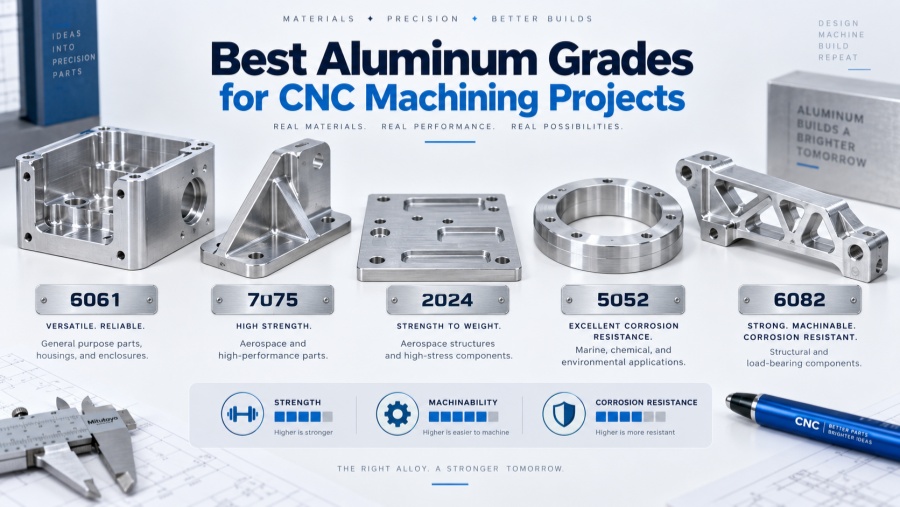
This guide explains some of the most common aluminum grades used in CNC machining, including 6061, 7075, 2024, 5052, and 6082.
Why Aluminum Is Popular for CNC Machining
Aluminum is widely used for CNC-machined parts because it offers a good balance of performance, weight, availability, and cost.
Common advantages include:
- Good machinability
- Low weight
- Good strength-to-weight ratio
- Good corrosion resistance
- Easy anodizing
- Good thermal conductivity
- Wide material availability
Aluminum is commonly used in automation equipment, electronics, robotics, aerospace, automotive parts, fixtures, housings, and many other applications.
Quick Comparison of Common Aluminum Grades
| Aluminum Grade | Strength | Corrosion Resistance | Machinability | Common Applications |
|---|---|---|---|---|
| 6061 | Medium | Good | Excellent | General mechanical parts, housings, fixtures |
| 7075 | Very High | Moderate | Very Good | Aerospace, robotics, high-load components |
| 2024 | High | Lower | Very Good | Aerospace structures, precision components |
| 5052 | Medium-Low | Excellent | Good | Marine parts, sheet-metal components |
| 6082 | Medium-High | Good | Very Good | Structural parts, machinery, European projects |
6061 Aluminum
6061 is one of the most common aluminum grades used in CNC machining.
It offers a very good balance of:
- Machinability
- Strength
- Corrosion resistance
- Weldability
- Cost
- Surface finishing performance
6061 is also easy to anodize and can achieve a clean cosmetic finish.
Typical applications include:
- CNC housings
- Electronic enclosures
- Brackets
- Fixtures
- Automation components
- Machine parts
- Prototype parts
For many general CNC projects, 6061 is often the first aluminum grade to consider.
7075 Aluminum
7075 is a high-strength aluminum alloy.
It is much stronger than 6061 and is often used when weight must remain low but mechanical strength is important.
Typical advantages include:
- Very high strength
- Good machinability
- Good fatigue performance
- High strength-to-weight ratio
Common applications include:
- Aerospace components
- Robotics
- Structural brackets
- High-load mechanical parts
- Precision fixtures
- Performance automotive components
7075 is more expensive than 6061 and generally has lower corrosion resistance.
It can also be anodized, although the final color may look slightly different from anodized 6061.
6061 vs. 7075
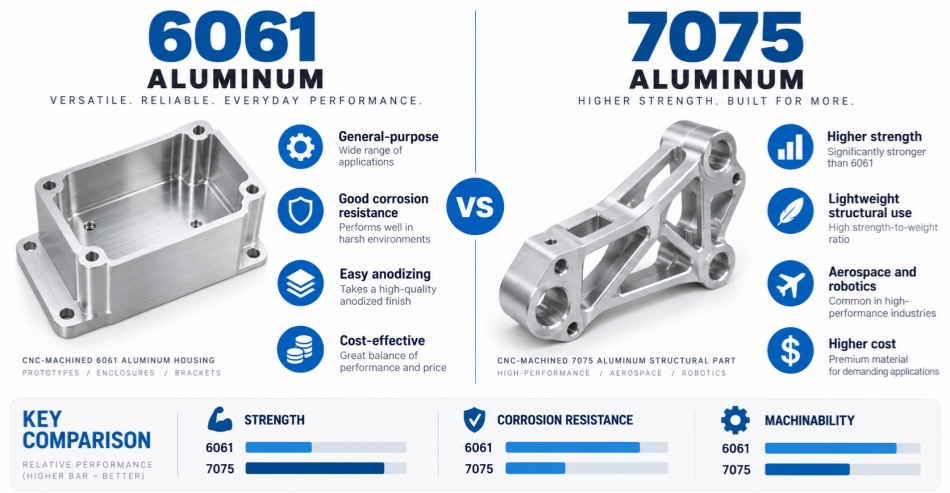
6061 and 7075 are often compared because both are widely used for CNC machining.
If the part does not require the extra strength of 7075, 6061 is usually the more economical choice.
2024 Aluminum
2024 is another high-strength aluminum alloy commonly associated with aerospace applications.
It contains copper as an important alloying element, which helps provide good strength and fatigue resistance.
Typical advantages include:
- High strength
- Good fatigue resistance
- Good machinability
- Good dimensional stability
Common applications include:
- Aerospace components
- Aircraft structural parts
- Precision mechanical parts
- High-load components
- Transportation equipment
The main disadvantage of 2024 is its lower corrosion resistance compared with 6061.
For this reason, protective coatings or surface treatments may be required in some applications.
5052 Aluminum
5052 aluminum is known for its excellent corrosion resistance.
It is particularly suitable for marine environments and sheet-metal applications.
Typical advantages include:
- Excellent corrosion resistance
- Good formability
- Good weldability
- Good performance in marine environments
Common applications include:
- Marine components
- Covers
- Panels
- Electronic enclosures
- Sheet-metal parts
- Fuel tanks
- Outdoor components
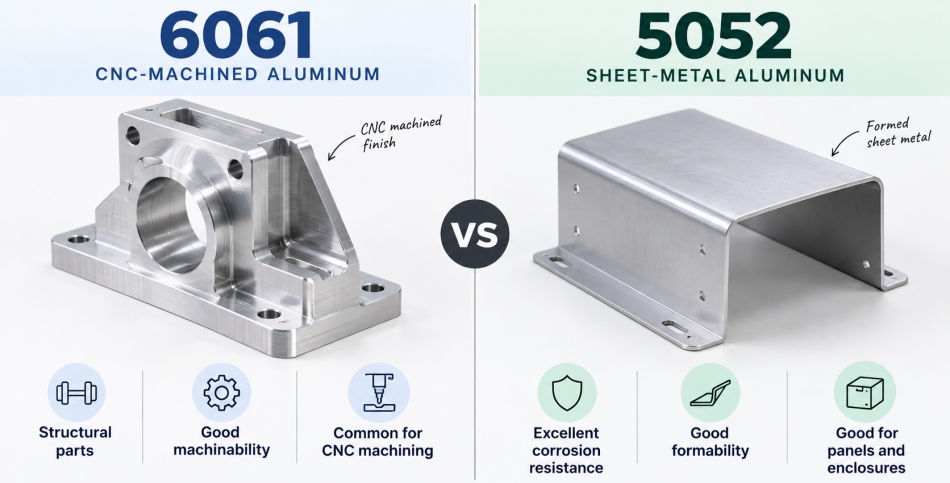
5052 is softer than 6061 and 7075.
It can still be CNC machined, but it is usually selected more for corrosion resistance and forming performance than for high-strength machined components.
6061 vs. 5052
6082 Aluminum
6082 is a medium-to-high-strength aluminum alloy that is commonly used in Europe.
Its properties are similar to 6061, but it can provide slightly higher strength in some conditions.
Typical advantages include:
- Good strength
- Good corrosion resistance
- Good machinability
- Good weldability
- Good structural performance
Common applications include:
- Machine components
- Structural brackets
- Frames
- Automation equipment
- Transportation components
- General industrial parts
6082 is especially common in European engineering projects.
For many CNC parts, it can be considered an alternative to 6061.
6061 vs. 6082
6061 and 6082 are relatively similar.
6061 is widely used in North America, while 6082 is more common in Europe.
- 6061 offers excellent general machinability and availability.
- 6082 can provide slightly higher strength.
- Both offer good corrosion resistance.
- Both are suitable for many CNC machining applications.
The final choice often depends on drawing requirements, regional material availability, and customer standards.
Which Aluminum Grade Has the Best Machinability?
For general CNC machining, 6061 is one of the easiest and most practical aluminum grades to machine.
7075 and 2024 also machine very well.
5052 can be machined, but because it is softer and more ductile, chip control and surface finish may require more attention.
Simple machinability comparison:
- 6061 — Excellent
- 7075 — Very good
- 2024 — Very good
- 6082 — Very good
- 5052 — Good
Actual machining performance also depends on tooling, cutting parameters, part geometry, and material temper.
Which Aluminum Grade Is Best for Anodizing?
6061 is one of the most popular grades for anodized CNC parts.
It usually produces a clean and consistent anodized appearance.
7075 can also be anodized, but the final color may be darker or less uniform.
5052 generally anodizes well and also provides strong corrosion resistance.
For cosmetic aluminum parts, the alloy should be selected together with the final anodizing requirement.
Which Aluminum Grade Has the Best Corrosion Resistance?
Among these common grades, 5052 offers excellent corrosion resistance.
6061 and 6082 also provide good corrosion resistance for many industrial applications.
7075 and 2024 provide higher strength but generally lower corrosion resistance.
For applications exposed to moisture, salt, or outdoor environments, corrosion performance should be considered carefully.
How to Choose the Right Aluminum Grade
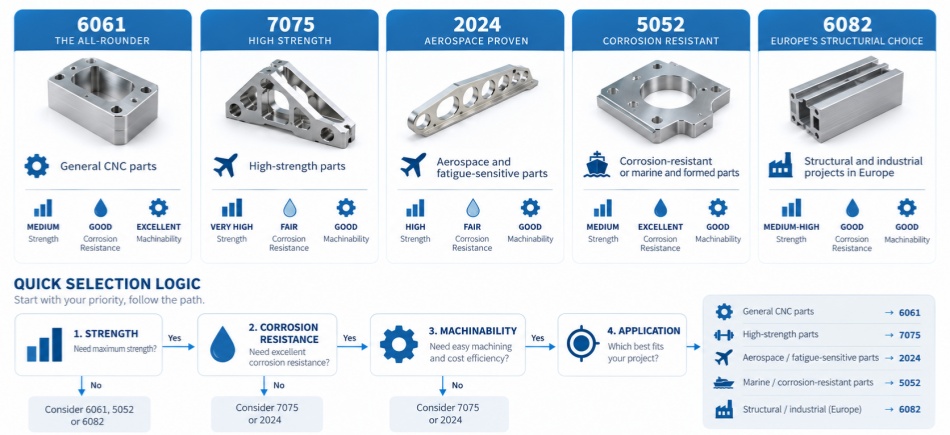
The best aluminum grade depends on the function of the part.
Practical Selection Guide
When choosing aluminum for CNC machining, consider:
- Required mechanical strength
- Part weight
- Corrosion resistance
- Machinability
- Surface finish or anodizing
- Welding requirements
- Material availability
- Material cost
Using a higher-strength alloy than necessary can increase material cost without improving the actual performance of the part.
Final Thoughts
There is no single aluminum grade that is best for every CNC machining project.
For most general-purpose CNC parts, 6061 offers an excellent balance of machinability, strength, corrosion resistance, and cost.
7075 is a better choice when higher strength is required, while 2024 is useful for demanding aerospace and fatigue-sensitive applications.
5052 is well suited for corrosion-resistant and formed components, and 6082 is widely used for structural and industrial parts, especially in Europe.
The best approach is to select the aluminum alloy based on the actual mechanical, environmental, and manufacturing requirements of the part.
Need Help Choosing an Aluminum Grade for Your CNC Part?
CNCTAL machines custom aluminum parts in 6061, 7075, 2024, 5052, 6082, and other aluminum alloys.
If you are unsure which aluminum grade is suitable for your project, send us your STEP and PDF drawings. Our engineering team can review the application and recommend a practical material option.
Request a CNC Machining Quote