
CNC Machining Cost for 10, 100 and 1,000 Parts ? What Buyers Should Expect
When purchasing custom CNC machined parts, quantity can have a major effect on unit price.
A quote for 10 parts may look expensive, while the price for 100 or 1,000 parts can be significantly lower per piece.
But CNC machining pricing does not decrease at the same rate for every project.
For purchasing teams, it is important to understand which costs can be spread across a larger quantity and which costs remain for every part produced.
Why Does CNC Machining Unit Price Change With Quantity?
Every CNC machining project includes two general types of cost:
- One-time or setup-related costs
- Costs that occur for every part produced
Setup-related costs may include:
- Engineering review
- CAM programming
- Machine setup
- Fixture preparation
- Tool preparation
- First-piece inspection
These costs are easier to spread across a larger production quantity.
However, other costs remain for every part:
- Raw material
- Machine cycle time
- Cutting tool wear
- Deburring
- Inspection
- Surface finishing
- Packaging
This is why the unit price usually drops as quantity increases, but it does not continue falling at the same rate forever.
CNC Machining Cost for 10 Parts
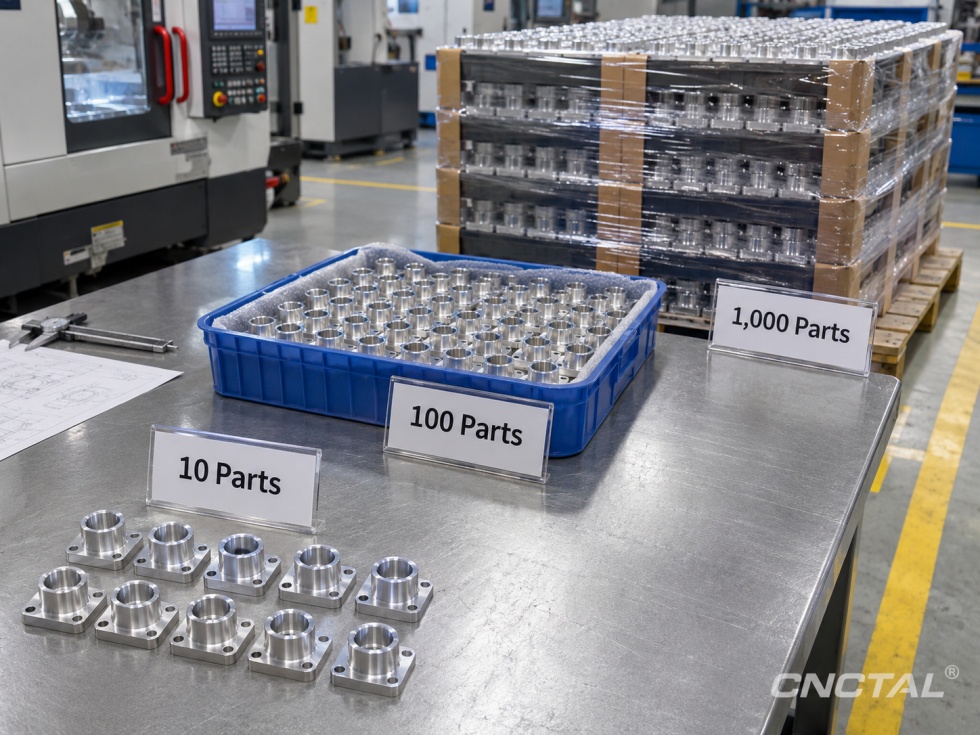
An order of 10 parts is generally considered a prototype or small-batch project.
At this quantity, setup and programming costs have a relatively large effect on unit price.
The supplier still needs to:
- Review the drawing
- Program the part
- Prepare tools
- Set up the machine
- Machine and inspect the first part
- Complete the remaining batch
What Buyers Should Expect at 10 Pieces
- Unit price is usually relatively high
- Setup cost has a strong impact
- Dedicated fixtures may not be economical
- Standard workholding is often preferred
- Lead time may be relatively short
- Design changes are still easier to manage
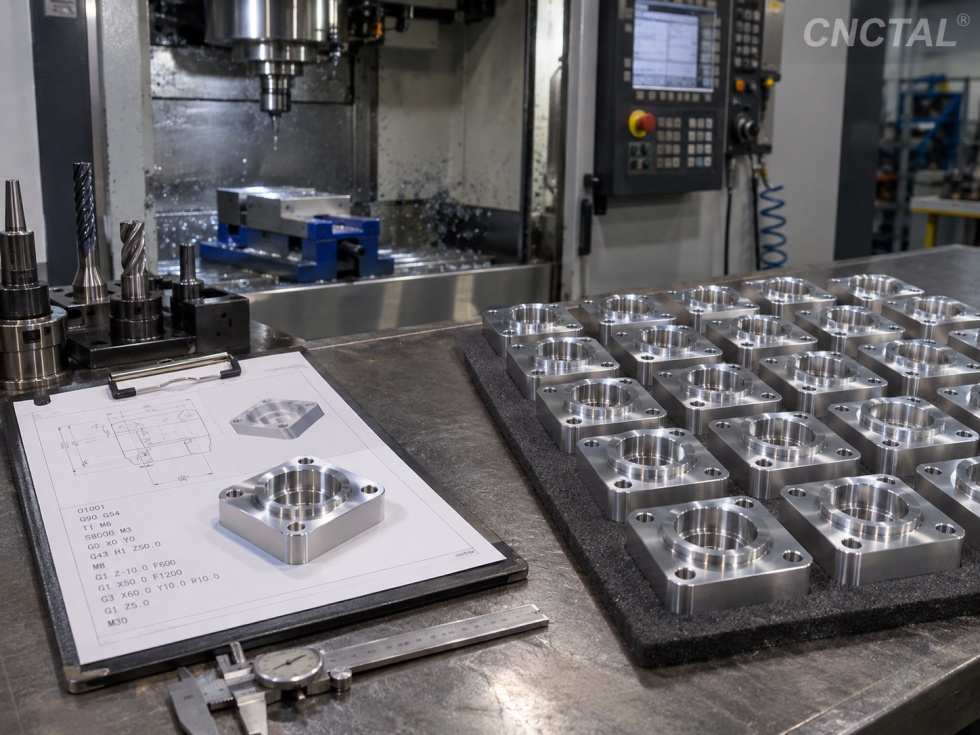
This quantity is suitable for functional prototypes, engineering samples, initial assembly testing, and product validation.
CNC Machining Cost for 100 Parts
At around 100 pieces, CNC machining often becomes more efficient.
Programming and setup costs can now be spread across a larger batch.
The supplier may also spend more time optimizing the process because these improvements can save meaningful production time.
Possible improvements include:
- Better fixture design
- Optimized cutting tools
- Improved toolpaths
- Multiple parts per setup
- More efficient inspection
- Batch surface finishing
What Buyers Should Expect at 100 Pieces
- Setup cost per part becomes much lower
- Fixtures may become worthwhile
- Machining cycles can be optimized
- Material purchasing may become more efficient
- Batch inspection becomes practical
- Unit price is usually more competitive
CNC Machining Cost for 1,000 Parts
At 1,000 pieces, the project should normally be treated as a production job rather than a prototype project.
The supplier has much more reason to optimize every part of the manufacturing process.
This may include:
- Dedicated production fixtures
- Multi-part workholding
- Tool-life planning
- Automated or semi-automated loading
- Optimized CNC programs
- Batch inspection plans
- More efficient material purchasing
- Repeatable finishing and packaging processes
These improvements can reduce the unit price.
However, buyers should not expect a 1,000-piece order to cost one-tenth per part compared with a 100-piece order.
Why Doesn’t the Price Keep Falling Dramatically?
Because many costs remain for every single part.
Consider a component that requires 20 minutes of machine time.
Whether you order 10, 100, or 1,000 pieces, each part still needs to be machined.
The supplier may reduce cycle time through optimization, but the machine still needs to manufacture every component.
The same applies to:
- Raw material
- Tool wear
- Deburring
- Anodizing
- Inspection
- Packaging
A Simple Cost Example
The following example is only intended to explain the pricing logic.
Assume a CNC project has:
- $300 of programming and setup cost
- $20 of material and machining cost per part
| Quantity | Setup Cost Per Part | Variable Cost | Approximate Unit Cost |
|---|---|---|---|
| 10 pcs | $30.00 | $20.00 | $50.00 |
| 100 pcs | $3.00 | $20.00 | $23.00 |
| 1,000 pcs | $0.30 | $20.00 | $20.30 |
This example shows why the biggest price reduction often occurs between very low quantities and medium quantities.
The difference between 100 and 1,000 pieces may be smaller because setup cost has already become a small part of the total price.
The Biggest Price Drop Is Not Always From 100 to 1,000
This is why buyers should not assume that ordering ten times more parts will automatically reduce the unit price by 50% or more.
Material Cost Still Matters at Higher Quantities
Material becomes especially important as production quantity increases.
For 10 pieces, a small material price difference may not have a major impact on the total project.
At 1,000 pieces, the same difference can become significant.
Material cost depends on factors such as:
- Aluminum vs. stainless steel
- 6061 vs. 7075 aluminum
- Standard steel vs. specialty steel
- Titanium
- Brass or copper
- PEEK and other high-cost engineering plastics
Simple Parts Scale Better Than Complex Parts
Quantity discounts are usually more noticeable on simple parts.
A basic CNC turned spacer may be very efficient to produce in large quantities.
A complex 5-axis aerospace component may still require significant machine time at 1,000 pieces.
Complex features that continue to affect every part include:
- Tight tolerances
- 5-axis machining
- Deep pockets
- Thin walls
- Multiple setups
- Complex threads
- Difficult inspection
- Fine surface finishes
Setup Reduction Can Make a Big Difference
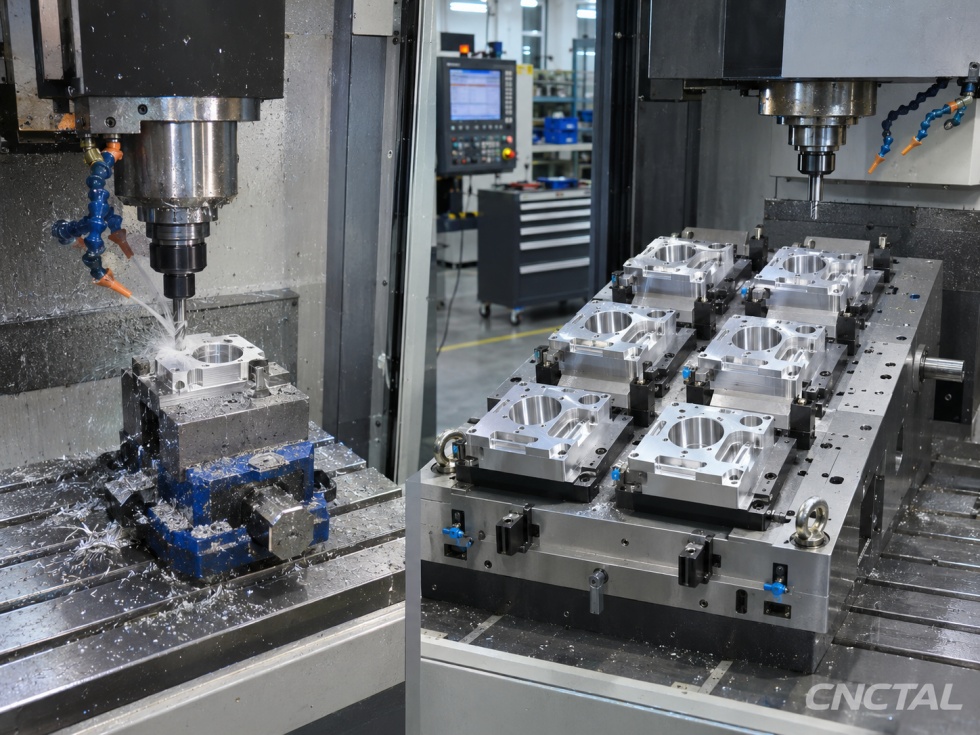
At higher quantities, suppliers often look for ways to reduce setups.
Prototype Production
A part may require three manual setups.
Production Optimization
A custom fixture may allow several operations to be completed in one setup.
This can reduce:
- Operator handling
- Datum alignment
- Inspection time
- Risk of positioning errors
For 10 pieces, building the fixture may not make financial sense.
For 1,000 pieces, it may save a significant amount of money.
Surface Finishing Does Not Always Get Much Cheaper
Processes such as:
- Anodizing
- Hard anodizing
- Passivation
- Black oxide
- Powder coating
- Plating
- Polishing
may become somewhat more efficient at higher quantities.
However, finishing still has a cost for every part.
Some projects also require masking, cosmetic inspection, individual protection, or special packaging.
These requirements can limit the amount of price reduction available.
Inspection Cost Changes With Quantity
Inspection strategy also changes as production quantities grow.
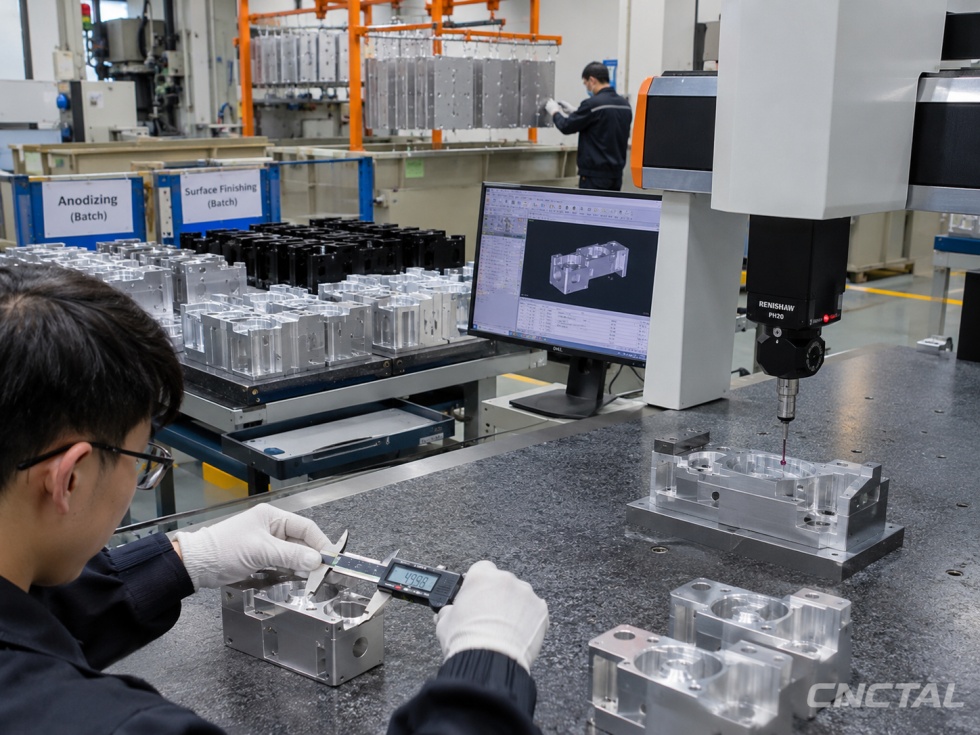
For 10 prototype parts, a supplier may inspect many dimensions on every part.
For a stable 1,000-piece production run, inspection may use a defined sampling plan, depending on customer requirements.
However, critical dimensions may still require frequent or 100% inspection.
Buyers should clearly specify whether they require:
- Standard inspection
- CMM report
- First Article Inspection
- Full dimensional report
- 100% inspection
- Material certification
10 vs. 100 vs. 1,000 Parts: Quick Comparison
| Factor | 10 Parts | 100 Parts | 1,000 Parts |
|---|---|---|---|
| Setup Cost Per Part | High | Lower | Very Low |
| Fixture Investment | Usually Limited | Sometimes Useful | Often Worthwhile |
| Process Optimization | Basic | Moderate | High |
| Material Purchasing | Small Batch | Better | More Efficient |
| Unit Price | Highest | Lower | Usually Lowest |
| Design Flexibility | High | Medium | Lower |
| Production Planning | Simple | Batch Production | Full Production Process |
Should Buyers Order 1,000 Parts Just to Get a Lower Price?
Not necessarily.
A lower unit price is useful only if you actually need the parts.
Ordering too many parts creates other costs:
- Inventory
- Storage
- Cash tied up in stock
- Risk of design changes
- Obsolete parts
- Forecast uncertainty
For new products, it may be smarter to order 10 prototypes first, then 100 pilot-production parts, and move to 1,000 pieces only after the design is approved.
Ask for Price Breaks in Your RFQ
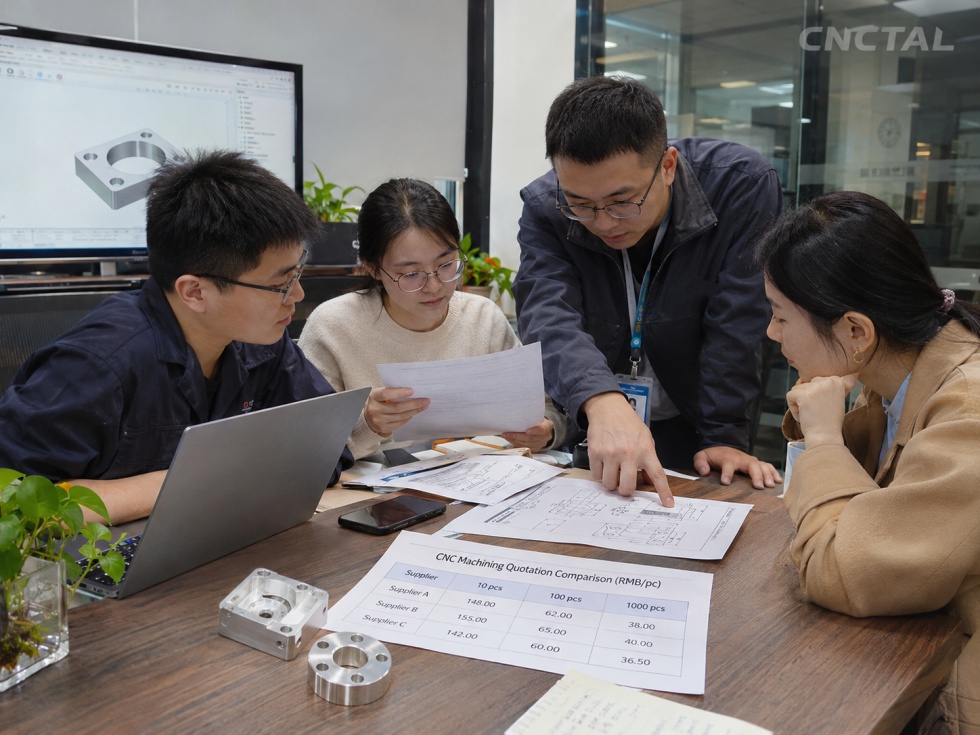
One of the best ways to understand CNC machining pricing is to request several quantities in the same RFQ.
For example:
- 10 pcs
- 100 pcs
- 500 pcs
- 1,000 pcs
This gives buyers a clear view of the supplier’s pricing curve.
It also shows whether the supplier is better suited for prototype work, low-volume manufacturing, or production quantities.
Annual Volume Is Also Important
If you expect to use 1,000 parts per year, tell the supplier how you expect to purchase them.
For example:
Annual volume: 1,000 pcs
Delivery: 250 pcs per quarter
This is different from ordering all 1,000 pieces at once.
The supplier may need to:
- Store raw material
- Repeat setups
- Maintain fixtures
- Manage multiple shipments
These factors can affect pricing.
Compare Total Cost, Not Only Unit Price
When comparing quotations for production quantities, consider more than the part price.
Also compare:
- Tooling or fixture cost
- Inspection cost
- Surface finishing
- Packaging
- Freight
- Import costs
- Lead time
- Quality risk
- Rework risk
A supplier that quotes $1 less per part may not actually be cheaper if quality problems or delivery delays occur.
When Should Buyers Negotiate Production Pricing?
The best time to discuss production pricing is after the supplier understands the actual part.
A practical process is:
- Quote and produce prototypes.
- Confirm the manufacturing process.
- Approve the sample.
- Review expected annual quantity.
- Ask for optimized production pricing.
Once the supplier has real machining data, they can usually provide a more accurate production price.
What Should Buyers Include in a CNC RFQ?
For accurate quantity pricing, provide:
- STEP file
- 2D drawing
- Material grade
- Surface finish
- Critical tolerances
- Quantity levels
- Annual demand
- Delivery schedule
- Inspection requirements
- Shipping destination
The more complete the RFQ, the easier it is to compare different suppliers fairly.
Final Thoughts
CNC machining unit price normally decreases as order quantity increases, but the relationship is not linear.
For 10 parts, setup and programming have a large impact on unit cost.
At 100 parts, those costs are spread across a larger batch and the manufacturing process becomes more efficient.
At 1,000 parts, the supplier can optimize fixtures, tooling, material purchasing, and production planning—but material and machine time still remain for every part.
For purchasing teams, the best strategy is to request multiple quantity price breaks and compare the complete production cost.
Need Pricing for 10, 100 or 1,000 CNC Parts?
CNCTAL supports CNC machining from prototypes and low-volume production to repeat production quantities.
If your project may grow from 10 parts to 100 or 1,000 parts, send us your STEP file, drawing, material, and expected quantities. We can review both prototype and production requirements when preparing the quotation.
Request a CNC Machining Quote