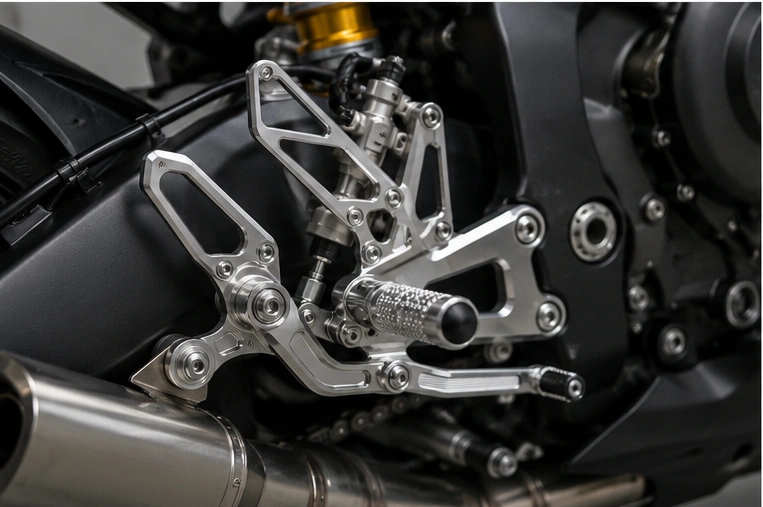

China vs. USA CNC Machining: Cost, Quality and Lead Time Comparison
When sourcing custom CNC machined parts, buyers often compare suppliers in China and the United States.
The question is usually simple:
Should we buy CNC machined parts from China or from a U.S. supplier?
There is no single answer for every project.
U.S. CNC shops often have advantages in local communication, urgent delivery, engineering collaboration, and projects that require frequent design changes.
Chinese CNC suppliers are often more competitive for production cost, larger batches, flexible capacity, and projects that require multiple secondary processes.
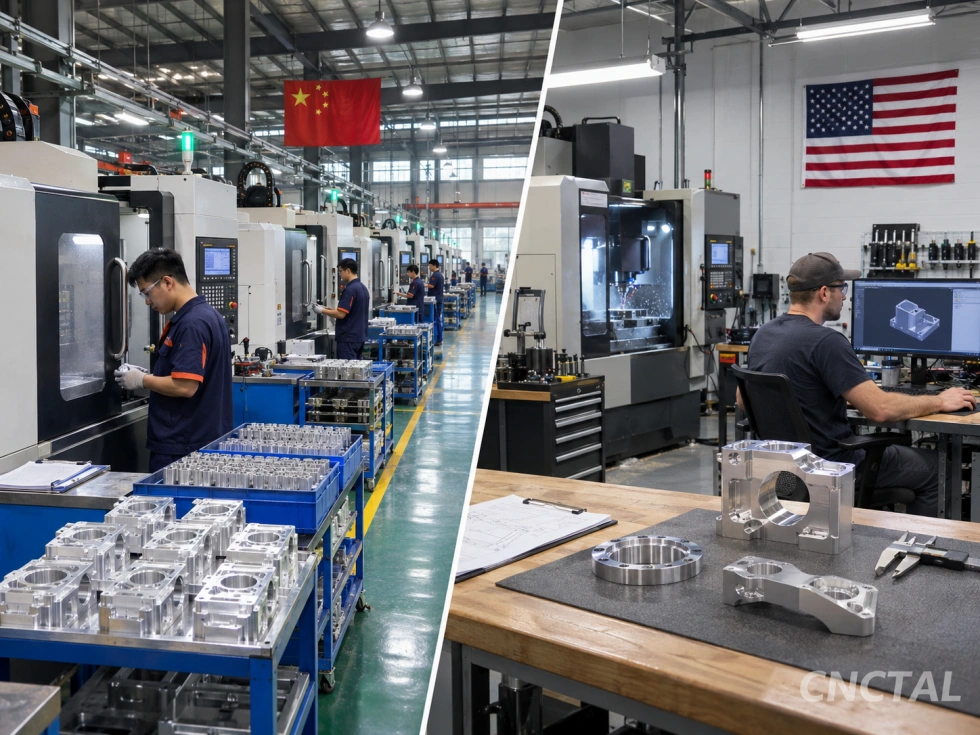
China vs. USA CNC Machining: Quick Comparison
| Factor | China CNC Machining | USA CNC Machining |
|---|---|---|
| Machining Cost | Usually more competitive | Usually higher |
| Prototype Speed | Good | Often faster for U.S. buyers |
| International Shipping | Required | Not required for U.S. buyers |
| Production Capacity | Strong for batch production | Strong, but varies by shop |
| Engineering Communication | Depends on supplier | Easier for local teams |
| Surface Finishing Network | Very strong in major manufacturing regions | Available, but may involve separate vendors |
| Quality | High with qualified suppliers | High with qualified suppliers |
| On-Site Supplier Audits | More difficult for U.S. buyers | Easier |
| Best Fit | Cost-sensitive production and repeat orders | Urgent, local, revision-heavy work |
Quality depends more on the supplier’s process, equipment, engineering capability, and quality system than on the country itself.
1. CNC Machining Cost: China vs. USA
Cost is usually the first difference buyers notice.
Chinese CNC suppliers often have lower manufacturing costs for labor-intensive machining and batch production.
This advantage can come from:
- Lower operating costs
- Dense supplier networks
- Flexible machine capacity
- Competitive material sourcing
- Efficient access to secondary processes
U.S. suppliers generally have higher labor and operating costs.
However, domestic production can reduce other expenses such as international freight, customs clearance, import duty, and inventory buffer.
2. Compare Quote Price With Landed Cost
A Chinese supplier may provide a lower unit price, but U.S. buyers may also need to pay:
- International freight
- Customs brokerage
- Import duty
- Tariffs
- Local delivery
China Landed Cost = Part Price + Freight + Duty + Customs + Local Delivery
USA Domestic Cost = Part Price + Domestic Freight
This is a much more accurate way to compare CNC machining suppliers.
3. When China Usually Has a Cost Advantage
China is often more competitive when the project includes:
- Medium or larger quantities
- Multiple machining operations
- Labor-intensive finishing
- Several secondary processes
- Repeat production
- Complex supply-chain coordination
For example, a project may require:
- CNC milling
- Bead blasting
- Anodizing
- Laser marking
- Inspection
- Packaging
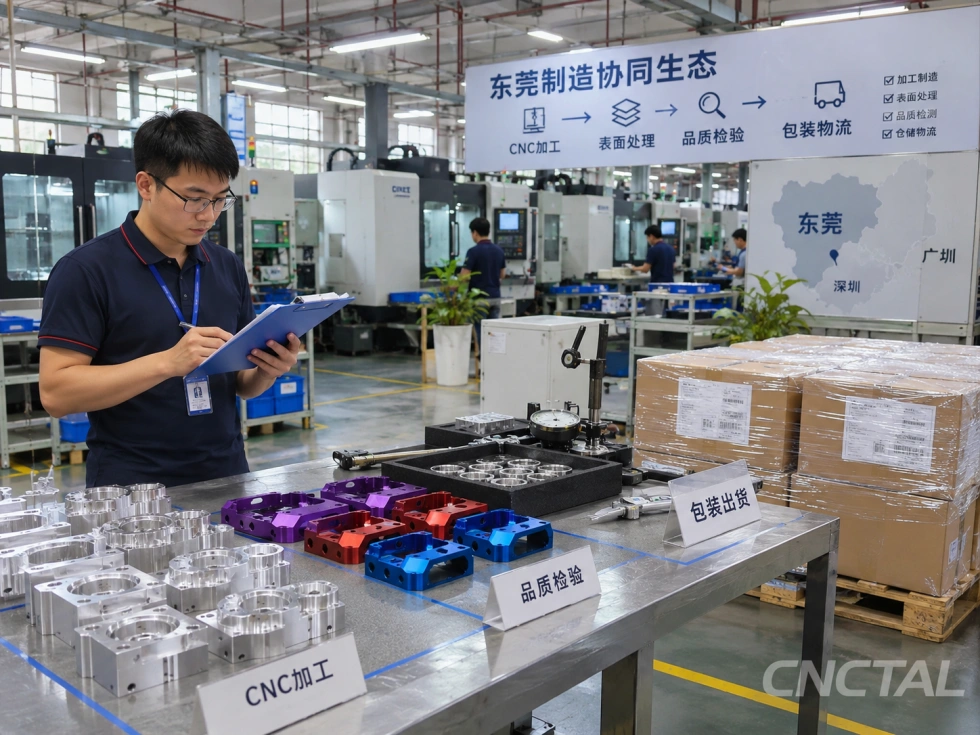
In manufacturing regions such as Guangdong, these processes can often be coordinated through a dense local supplier network.
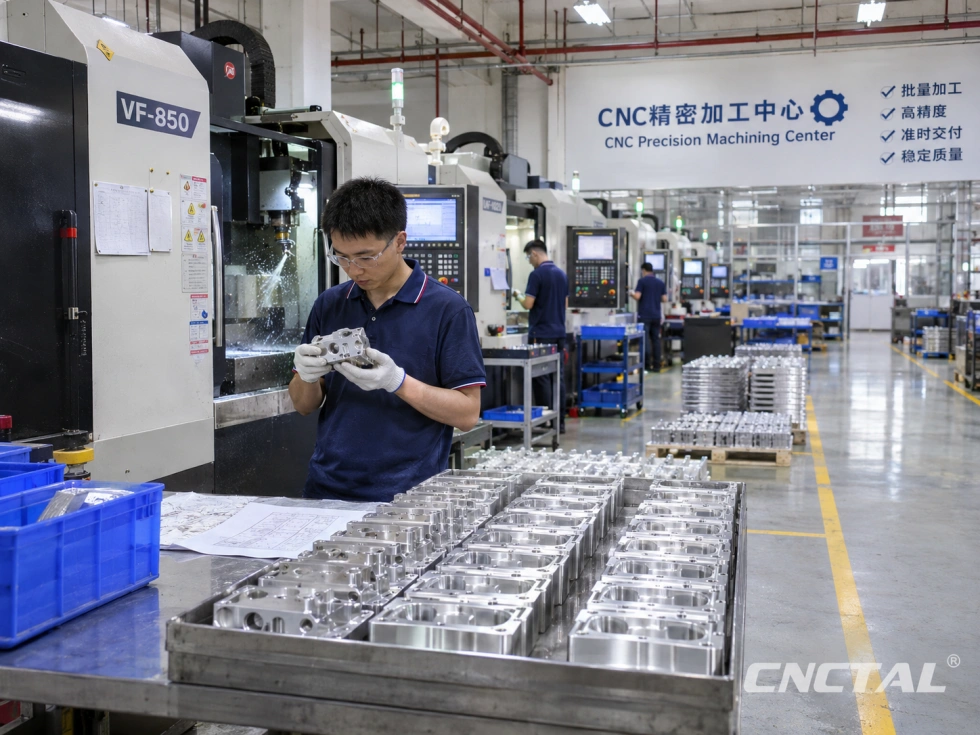
4. When a U.S. Supplier May Be More Economical
A U.S. supplier can be the better choice when:
- Only a few parts are required
- Delivery is extremely urgent
- Parts are large or heavy
- Freight costs are high
- Import duty significantly reduces the China cost advantage
- Engineers expect several design changes
- The project requires frequent face-to-face communication
For example, if an engineer needs three prototype parts within one week and expects another design revision immediately afterward, a local U.S. shop may save more time and engineering effort.
5. Lead Time: USA Is Often Faster for Urgent U.S. Projects
For U.S. customers, domestic CNC machining usually has an advantage in total delivery time.
There is no international customs process, and domestic shipping may only take a few days.
A typical domestic project may include:
- Programming
- Machining
- Inspection
- Domestic delivery
For a Chinese supplier, production itself may be fast, but international shipping still needs to be added.
Air freight can reduce this difference significantly, while sea freight is more suitable for larger or less urgent production shipments.
6. Air Freight Makes China More Practical for Small CNC Parts
Small precision CNC parts are often practical to ship by air.
Examples include:
- Aluminum brackets
- Precision shafts
- Small housings
- Bushings
- Fittings
- Robotics components
These parts can have a relatively high value compared with their shipping weight.
Large and heavy parts are different because international freight can become a much bigger percentage of the total cost.
7. Quality: China vs. USA
One of the biggest misconceptions is that country alone determines CNC machining quality.
It does not.
Both China and the United States have:
- Excellent CNC suppliers
- Average suppliers
- Poor suppliers
A professional supplier should control:
- Material
- CNC programming
- Tooling
- First-piece inspection
- Process inspection
- Final inspection
- Surface finishing
- Packaging
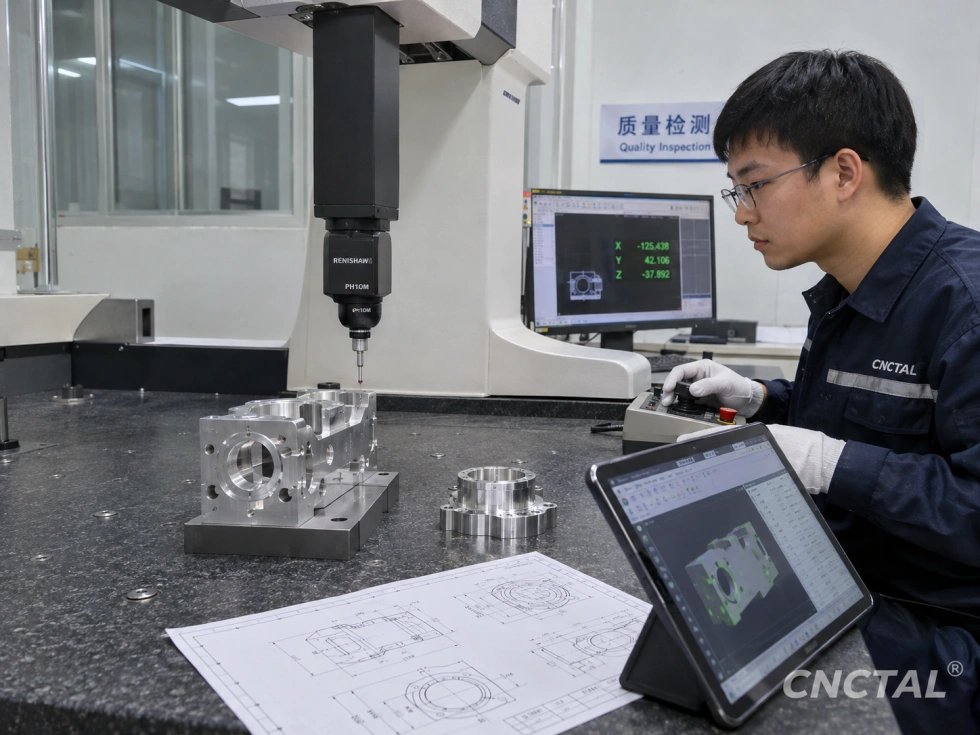
8. What Buyers Should Check Before Selecting a Chinese Supplier
If you are sourcing from China, check whether the supplier can provide:
- ISO quality management
- Material certificates
- CMM inspection
- Dimensional reports
- Thread gauges
- Surface roughness inspection
- First Article Inspection when required
- Clear English engineering communication
- Export experience
Do not select a supplier only because the quotation is cheap.
A qualified supplier should be able to explain how the part will be manufactured and inspected.
9. Quality Advantages of U.S. Suppliers
For U.S. companies, domestic suppliers can offer an important practical advantage:
It is easier to visit the factory.
Buyers and engineers may be able to:
- Review the process in person
- Inspect samples directly
- Discuss technical issues face to face
- Perform supplier audits
- Resolve problems quickly
This can be especially useful for highly regulated, confidential, or development-stage projects.
10. Communication and Time Zone Differences
With a U.S. supplier, engineering teams can usually communicate during the same working hours.
This makes drawing clarification, design revisions, urgent meetings, and problem solving easier.
When working with China, there is a large time-zone difference.
Experienced export manufacturers usually manage this with:
- Engineering reports
- Video meetings
- Drawing markups
- Fast quotation systems
For stable production projects, the time-zone difference is often manageable.
11. China Has a Strong Manufacturing Ecosystem
One of China’s biggest advantages is not only machining cost.
It is the manufacturing ecosystem.
Major industrial regions can provide access to:
- CNC machining
- Raw materials
- Heat treatment
- Anodizing
- Electroplating
- Grinding
- EDM
- Sheet metal
- Injection molding
- Assembly
- Packaging
- Export logistics
12. Why Dongguan, Guangdong Is Important for CNC Manufacturing
Dongguan is part of the Greater Bay Area manufacturing ecosystem.
The region has a large concentration of:
- CNC machine shops
- Tooling suppliers
- Surface finishing companies
- Mold manufacturers
- Electronics manufacturers
- Material distributors
- Export logistics providers
For international buyers, this supplier density can make it easier to complete machining, finishing, inspection, packaging, and shipping within the same manufacturing region.
13. USA Advantages: Local Engineering and Fast Iteration
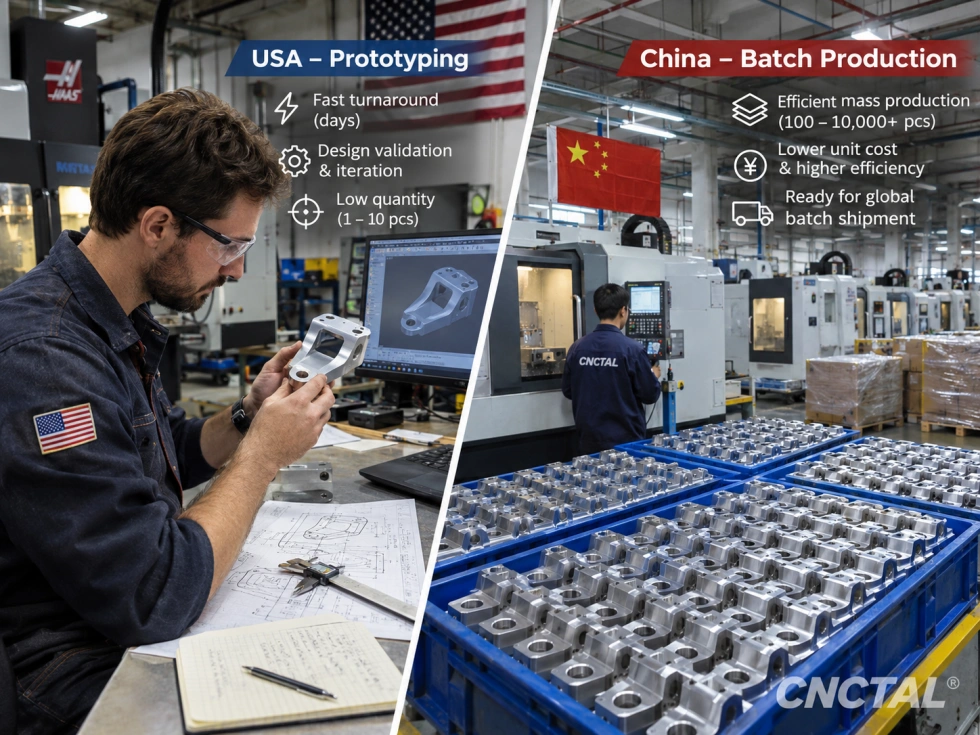
The U.S. manufacturing model has strong advantages during product development.
If the engineer changes a part several times in one month, domestic sourcing can make iteration easier.
A typical workflow may be:
- Send revised CAD model.
- Discuss the change the same day.
- Machine a new prototype.
- Ship domestically.
- Test immediately.
This can be very valuable during early-stage product development.
14. China Advantages: Scaling From Prototype to Production
China can be particularly attractive once the product design becomes stable.
A supplier may initially produce:
- 5 prototypes
- 50 engineering samples
- 500 production parts
- 5,000 repeat parts
At higher quantities, process optimization becomes more important.
The supplier can invest in:
- Production fixtures
- Multi-part workholding
- Tool-life optimization
- Material purchasing
- Batch finishing
- Repeatable inspection
15. Small Quantity vs. Production Quantity
16. Parts That May Be Better to Manufacture in the USA
Domestic U.S. sourcing may be better for:
- Emergency replacement parts
- Very urgent prototypes
- Large heavy components
- Frequent design revisions
- Projects requiring regular factory visits
- Certain regulated or restricted programs
- Parts where international freight removes the cost advantage
17. Parts That May Be Better to Manufacture in China
China may be a better option for:
- Cost-sensitive CNC parts
- Repeat production
- Low-to-medium volume batches
- Aluminum housings
- Robotics components
- Automation equipment parts
- Precision turned parts
- Parts requiring anodizing or plating
- Projects involving several manufacturing processes
18. Should Buyers Use Both China and USA Suppliers?
Sometimes the best answer is yes.
Many purchasing teams can use a hybrid sourcing strategy.
Early Development
Use a local U.S. supplier for fast prototypes and engineering changes.
Design Approved
Move to a qualified Chinese supplier for pilot production.
Repeat Production
Use China for larger production quantities when the economics make sense.
Emergency Demand
Maintain a domestic supplier as a backup if continuity is important.
China vs. USA CNC Machining: Buyer Decision Table
| Project Requirement | Better Starting Option |
|---|---|
| Same-week prototype | USA |
| Frequent design revisions | USA |
| Local factory visit required | USA |
| Large / heavy part | Often USA |
| Cost-sensitive batch production | China |
| Multiple secondary processes | China |
| Repeat production | China |
| 50–5,000+ parts | Often China |
| Stable design | China |
| Emergency supply | USA |
| Global production strategy | Consider both |
This table is a general guide, not a fixed rule.
The actual decision should be based on the part, quantity, shipping cost, quality requirements, and supplier quotation.
19. What Buyers Should Compare in Every RFQ
Whether you choose China or the USA, compare suppliers using the same information.
- Part price
- Material specification
- Setup and tooling costs
- Surface finishing
- Inspection
- Lead time
- Freight
- Import duties
- Packaging
- Engineering support
- Repeat production capability
- Total landed cost
The best comparison is not simply China price vs. USA price. It is the complete cost and risk of getting acceptable parts delivered when you need them.
Final Thoughts
China and the United States both have strong CNC machining capabilities.
The U.S. often has an advantage for urgent prototypes, local communication, engineering iteration, and projects requiring easy supplier access.
China often has an advantage for cost-sensitive production, repeat orders, flexible capacity, and projects requiring multiple manufacturing processes.
For buyers, the question should not be:
“Which country is better?”
A better question is:
“Which sourcing option fits this project best?”
For some projects, the USA is the right answer.
For others, China provides better total value.
And for many companies, using both regions at different stages of the product lifecycle can be the most practical strategy.
Comparing a China CNC Quote With a U.S. Supplier?
CNCTAL in Dongguan, Guangdong supports CNC machining from prototypes to low-volume and repeat production, with machining, inspection, and surface finishing coordinated around the actual project requirements.
Send us your STEP file, drawing, material, quantity, and finishing requirements. We can prepare a clear quotation that makes the manufacturing scope easier to compare.
Request a CNC Machining Quote