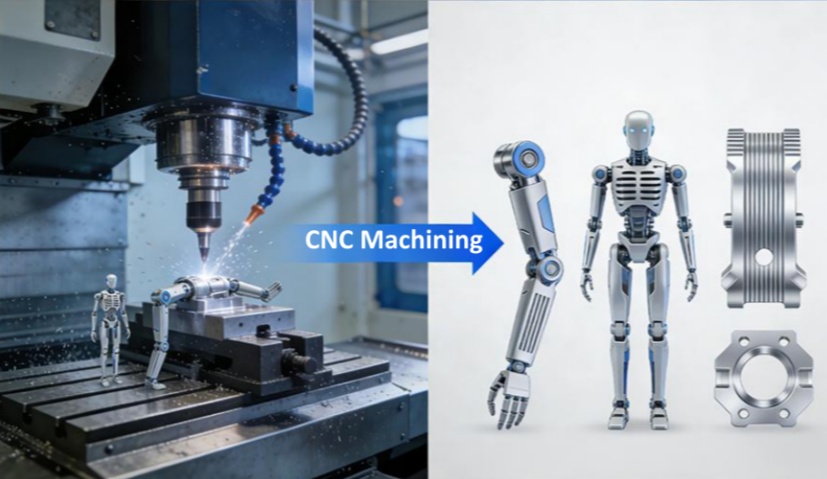

Aluminum Anodizing Guide: Type II vs. Type III, Colors, Corrosion Resistance, and Dimensional Changes
Aluminum anodizing is one of the most common surface finishes used for CNC-machined aluminum parts.
It improves corrosion resistance, increases surface durability, and can also provide different colors for appearance or product identification.
For CNC parts, the two most common anodizing types are Type II anodizing and Type III hard anodizing.
This guide explains the main differences between them, common color choices, corrosion resistance, and how anodizing can affect final part dimensions.
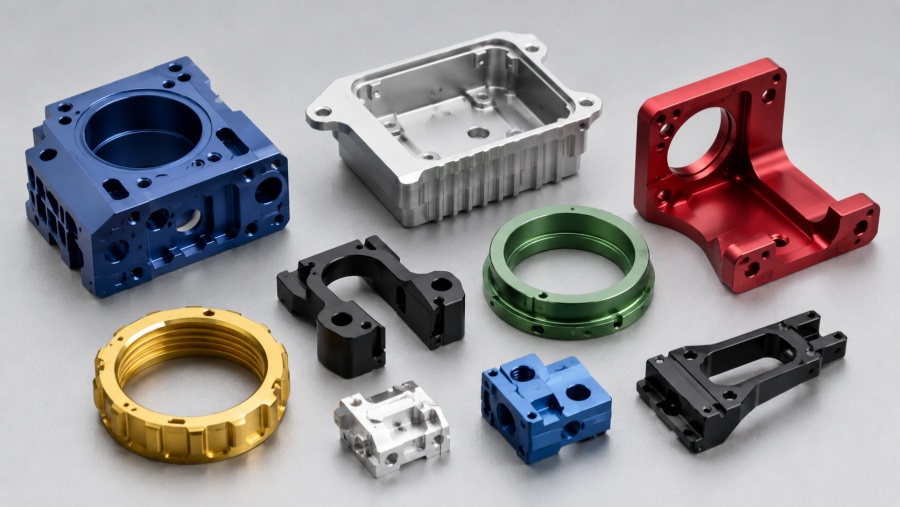
What Is Aluminum Anodizing?
Anodizing is an electrochemical process that creates a controlled oxide layer on the surface of aluminum.
Unlike paint, the anodized layer becomes part of the aluminum surface itself.
The process can improve:
- Corrosion resistance
- Surface hardness
- Wear resistance
- Appearance
- Color options
- Surface durability
Anodizing is commonly used on CNC aluminum parts for electronics, automation equipment, aerospace, robotics, consumer products, and industrial machinery.
Type II vs. Type III Anodizing
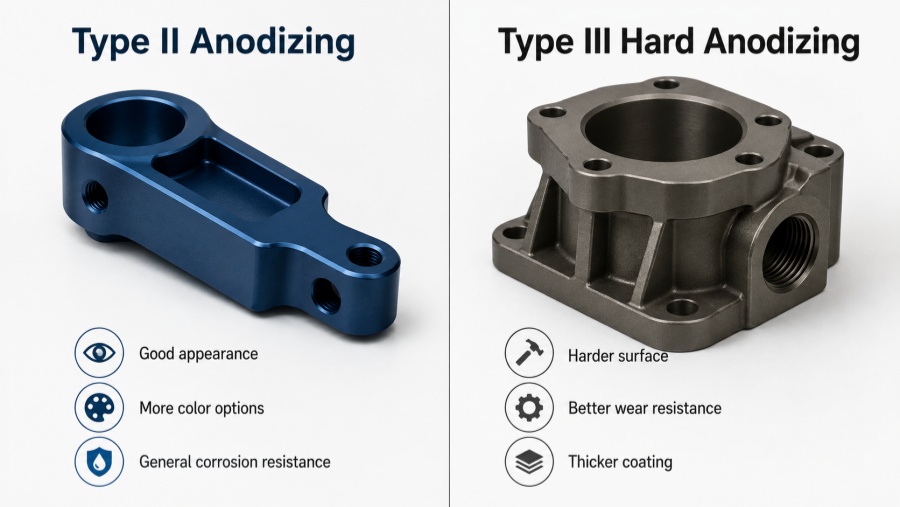
The main difference between Type II and Type III anodizing is the thickness and hardness of the anodized layer.
| Anodizing Type | Main Purpose | Typical Characteristics |
|---|---|---|
| Type II | General protection and appearance | Thinner coating, good corrosion resistance, many color options |
| Type III | Wear resistance and durability | Thicker and harder coating, better abrasion resistance |
What Is Type II Anodizing?
Type II anodizing is the most common anodizing process for general CNC aluminum parts.
It provides good corrosion resistance and allows a wide range of dyed colors.
Typical advantages include:
- Good corrosion protection
- Good cosmetic appearance
- Many color choices
- Relatively thin coating
- Suitable for general industrial parts
Common applications include:
- Aluminum housings
- Electronic enclosures
- Brackets
- Covers
- Control panels
- Consumer product parts
- General mechanical components
For many CNC projects, Type II anodizing offers a good balance between appearance, protection, and cost.
What Is Type III Hard Anodizing?
Type III anodizing is also known as hard anodizing or hardcoat anodizing.
It produces a thicker and harder oxide layer than Type II anodizing.
This makes it more suitable for parts that experience wear, friction, or demanding working conditions.
Typical advantages include:
- Higher surface hardness
- Better wear resistance
- Better abrasion resistance
- Strong corrosion resistance
- Longer service life in demanding applications
Typical applications include machine parts, fixtures, aerospace components, hydraulic parts, and other high-wear aluminum components.
Simple rule: choose Type II when appearance and general protection matter most. Choose Type III when hardness and wear resistance are more important.
Common Anodizing Colors
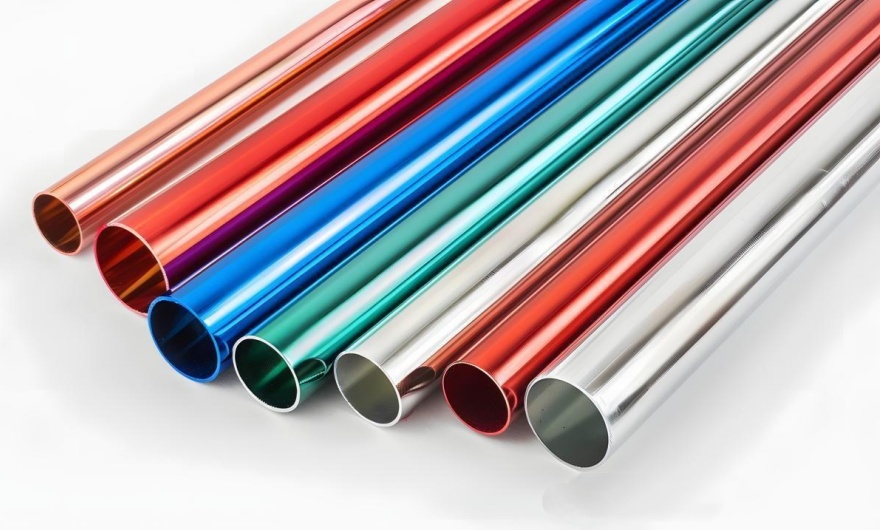
Type II anodizing can be dyed in many different colors.
Common choices include:
Black anodizing is one of the most common choices for CNC-machined parts.
Clear anodizing is also widely used when the customer wants to keep a natural aluminum appearance while improving corrosion resistance.
Why Can Anodized Colors Vary?
Anodized colors are not always perfectly identical from batch to batch.
The final appearance can be affected by:
- Aluminum alloy
- Surface preparation
- Coating thickness
- Dye concentration
- Anodizing process conditions
- Part geometry
- Sealing process
For example, 6061 and 7075 aluminum may not produce exactly the same color even when the same anodizing process is used.
Light colors are usually more sensitive to small color differences than black anodizing.
If color matching is critical, provide a physical sample or approved color reference before production.
This is especially important when several parts must match visually in the same final assembly.
How Does Aluminum Alloy Affect Anodizing?
6061 Aluminum
6061 usually anodizes well and is commonly used for cosmetic CNC parts.
It can produce a relatively clean and consistent anodized finish.
7075 Aluminum
7075 can also be anodized, but the final appearance may be darker or slightly different from 6061 because of its alloy composition.
This is important when different aluminum grades are used in the same assembly.
Corrosion Resistance of Anodized Aluminum
Aluminum naturally forms a thin oxide layer when exposed to air.
Anodizing makes this oxide layer thicker and more controlled, helping improve the corrosion resistance of the aluminum surface.
Type II anodizing provides good corrosion resistance for many general indoor and outdoor applications.
Type III anodizing can provide strong protection for more demanding environments, especially when wear resistance is also important.
Anodizing improves corrosion resistance, but it does not make aluminum completely corrosion-proof. Strong chemicals, salt exposure, damaged surfaces, or poor sealing can still affect the part.
Does Anodizing Hide CNC Tool Marks?
Usually, no.
Anodizing follows the existing surface condition of the machined part.
If visible CNC cutter marks, scratches, dents, or surface defects are present before anodizing, they may still be visible afterward.
For cosmetic parts, surface preparation is therefore important.
Common preparation methods include:
- Fine CNC finishing
- Bead blasting
- Brushing
- Polishing
Bead blasting before anodizing is especially common when a more uniform matte appearance is required.
Does Anodizing Change Part Dimensions?
Yes.
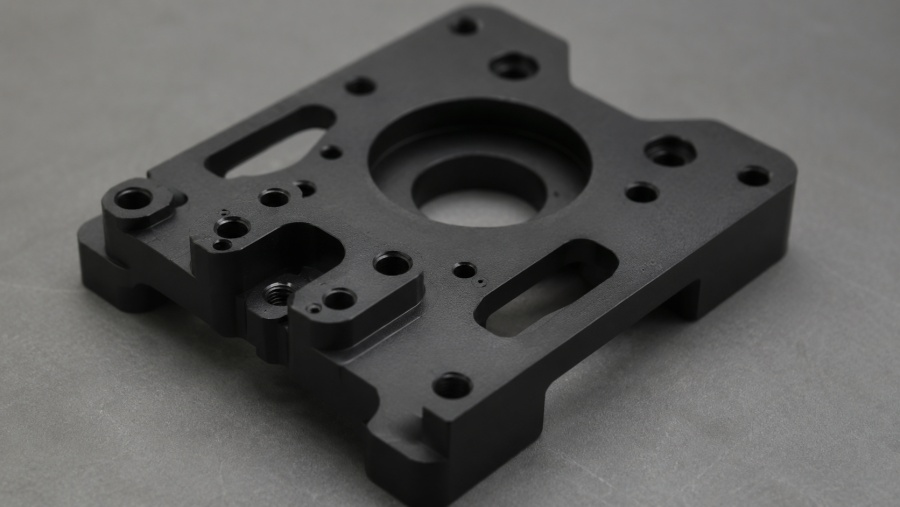
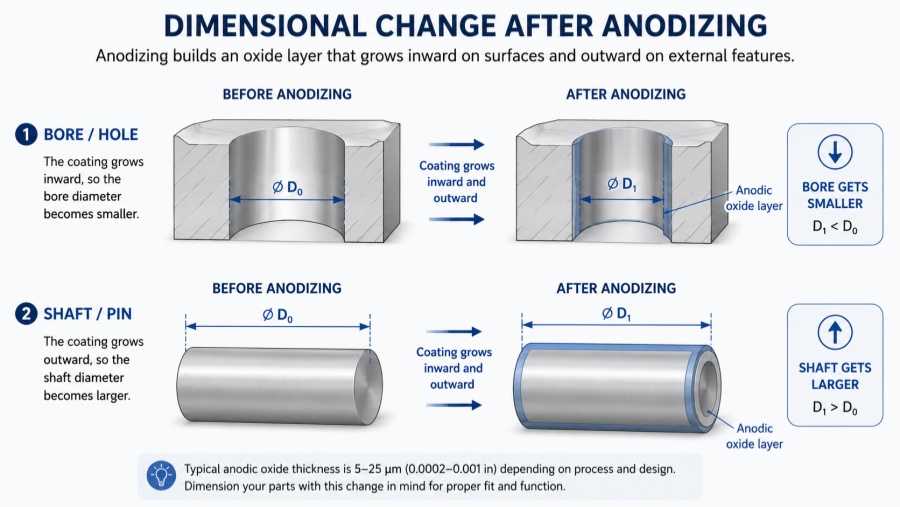
Anodizing creates an oxide layer on the aluminum surface, so the final dimensions of the part can change slightly.
Part of the anodized layer grows into the original aluminum surface, while part grows outward.
This means anodizing can affect precision features such as:
- Holes
- Bores
- Shafts
- Bearing seats
- Threads
- Sliding fits
- Mating surfaces
The dimensional effect becomes more important as the anodized layer gets thicker.
Type II Dimensional Changes
Type II anodizing normally uses a thinner coating.
Because of this, dimensional changes are usually small for general CNC parts.
However, tight-tolerance holes and mating features still need to be considered.
If a drawing contains precision fits, the CNC supplier should know that the required dimensions apply after anodizing.
Type III Dimensional Changes
Type III hard anodizing is thicker than Type II.
Therefore, its effect on final dimensions can be more important.
For example, a precision bore may become smaller after anodizing, while a shaft may become slightly larger.
The machining dimensions may therefore need to be adjusted before hard anodizing.
This is especially important for:
- Bearing fits
- Sliding components
- Precision bores
- Tight mating surfaces
For tight-tolerance parts, anodizing should be considered during CNC programming and machining — not only after the part has already been finished.
Anodizing and Threads
Threads also require attention.
When a thread is anodized, the coating grows on the thread surfaces and can make the fit tighter.
For some standard threads, this may not cause a problem.
For critical threads, the drawing should clearly state whether the thread should be:
- Anodized
- Masked during anodizing
- Machined after anodizing
The correct choice depends on the thread size, coating thickness, and required fit.
When Is Masking Needed?
Some surfaces should not receive anodizing.
These areas can be protected by masking before anodizing.
Masking is commonly used for:
- Electrical grounding surfaces
- Electrical contact areas
- Bearing fits
- Tight-tolerance bores
- Certain threads
- Critical sealing surfaces
If masking is required, the drawing should clearly identify those areas.
Practical Tips for CNC Designers
When specifying anodizing for CNC aluminum parts, keep these points in mind:
- Use Type II for general protection and cosmetic appearance.
- Use Type III for harder and more wear-resistant surfaces.
- Do not expect anodizing to remove machining marks.
- Remember that different aluminum alloys can produce different colors.
- Specify important color requirements clearly.
- Consider coating thickness on precision dimensions.
- Pay special attention to threads, holes, shafts, and bearing fits.
- Mark any surfaces that require masking.
Final Thoughts
Aluminum anodizing is a practical and widely used finish for CNC-machined aluminum parts.
Type II anodizing is a good choice for general corrosion resistance, appearance, and color options.
Type III hard anodizing is better suited for parts that need higher hardness, wear resistance, and durability.
The most important point is to consider anodizing during the design and machining stage, especially when the part has tight tolerances or critical mating features.
Need Anodized CNC Aluminum Parts?
CNCTAL manufactures custom CNC aluminum parts with Type II anodizing, Type III hard anodizing, bead blasting, polishing, and other surface finishing options.
If your project includes specific anodizing colors, coating requirements, masking areas, or tight post-anodizing dimensions, send us your STEP and PDF files for review.
Request a CNC Machining Quote