
What Affects CNC Machining Pricing? A Simple Guide for Engineers
CNC machining prices can vary greatly, even when two parts look similar in size.
For mechanical engineers and product designers, understanding what increases machining difficulty can help reduce unnecessary cost before a drawing is sent for quotation.
In most CNC projects, price is mainly affected by material, geometry complexity, tolerances, surface finish, machining time, number of setups, quantity, and secondary operations.
1. Material Choice
Material is one of the first factors that affects CNC machining cost.
Different materials have different:
- Raw material prices
- Cutting speeds
- Tool wear
- Machining difficulty
For example, aluminum is generally faster and easier to machine than stainless steel or titanium.
Aluminum
Aluminum alloys such as 6061 are widely used because they machine quickly and usually cause relatively low tool wear.
This often makes aluminum parts more economical.
Stainless Steel
Stainless steel is tougher and usually requires slower cutting speeds.
It can also create more heat and tool wear, increasing machining time.
Titanium
Titanium is strong and lightweight, but it is more difficult to machine.
It usually requires slower cutting, careful tool selection, and longer machining time.
Engineering Plastics
Materials such as POM, PEEK, Nylon, and PTFE can also vary greatly in cost.
Some plastics are easy to machine, while others are expensive raw materials or require special cutting conditions.
2. Part Geometry and Complexity
Part geometry is one of the biggest reasons CNC prices can differ.
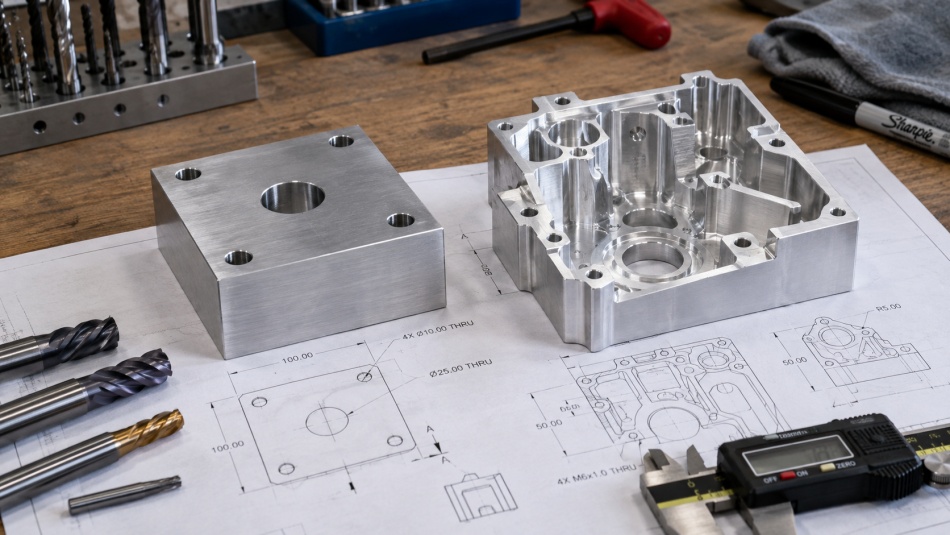
A simple block with a few holes may be quick to machine.
A similar-sized part with the following features can take much longer:
- Deep pockets
- Thin walls
- Small internal radii
- Complex 3D surfaces
- Multiple angled holes
- Undercuts
- Difficult-to-reach features
More complex geometry usually means more programming, more tool changes, longer cycle time, more inspection, and higher machining risk.
3. Deep Pockets
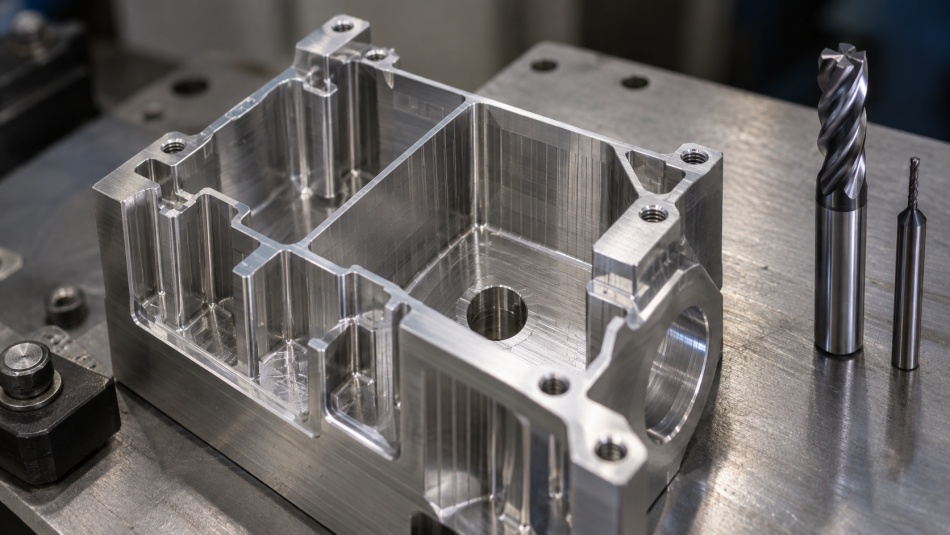
Deep pockets can significantly increase machining difficulty.
The deeper the pocket, the longer the cutting tool may need to be.
Long tools are less rigid and more likely to:
- Vibrate
- Deflect
- Break
- Produce poor surface finish
Machinists may need to reduce cutting depth and feed rate, which increases machining time.
4. Small Internal Corner Radii
CNC milling tools are round, so very small internal corner radii require small end mills.
Small tools remove material more slowly and are more likely to break.
For example, a large pocket may be machined quickly with a 10 mm end mill, but an R1 internal corner may require an additional 2 mm cutter.
That means another tool change, another machining operation, and more cycle time.
5. Thin Walls
Thin walls can make CNC machining more difficult because they may:
- Vibrate during cutting
- Bend under cutting forces
- Distort after material removal
- Become difficult to hold accurately
To protect the part, the machinist may need to use smaller cuts and slower feeds.
6. Tight Tolerances
Tighter tolerances usually increase machining cost.
For example, a general tolerance of ±0.10 mm is much easier to achieve than ±0.01 mm.
Tight tolerances may require:
- More finishing passes
- Slower machining
- More careful setup
- More inspection
Not every feature needs a tight tolerance.
A good design applies tight tolerances only to important functional features.
7. Surface Finish Requirements
Surface finish also affects price.
A standard machined surface is usually faster to produce.
If the drawing requires:
- Ra 0.8 µm
- Ra 0.4 µm
- Polishing
- Mirror finish
- Cosmetic surfaces
additional finishing operations may be required.
8. Number of Setups
Setup time is another major cost factor.
If a part can be machined from one side or with only two setups, production is usually more efficient.
But if the part requires machining from many different directions, the operator may need to:
- Remove the part
- Reposition it
- Re-clamp it
- Re-align the datum
- Inspect again
Every additional setup adds labor and machine time.
9. Too Many Machining Directions
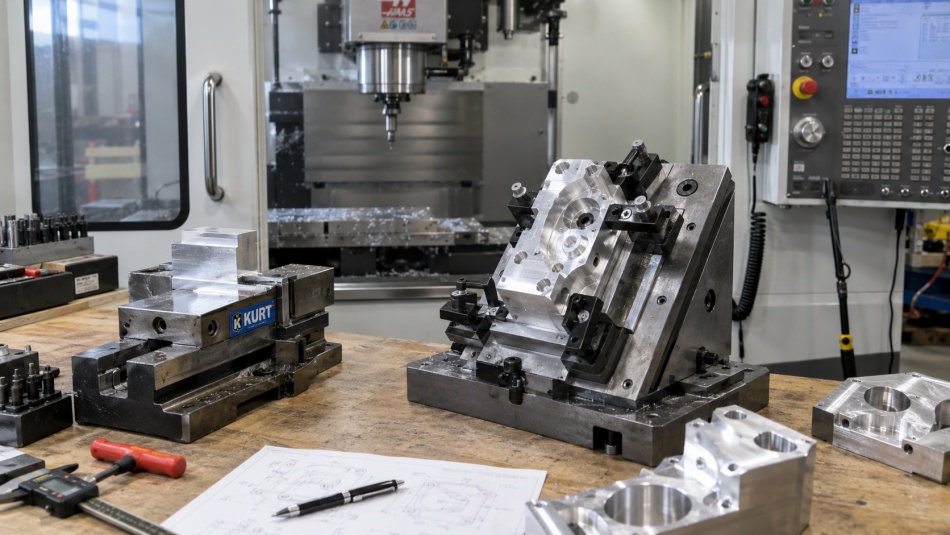
A part with features on all six sides may require several operations on a standard 3-axis machine.
Using a 5-axis machine can reduce setups in some cases, but the machine rate is usually higher.
The best manufacturing method depends on:
- Part geometry
- Quantity
- Tolerance requirements
- Machine availability
10. Tool Accessibility
Every feature must be reachable by a cutting tool.
Some designs contain features that are difficult to access, such as:
- Deep narrow slots
- Undercuts
- Internal side holes
- Small features close to walls
- Complex internal channels
These may require special tools or additional setups.
11. Part Size and Material Removal
Large parts generally cost more because they require more raw material.
But part size is not the only issue.
The amount of material removed also matters.
For example, machining a finished part from a large solid aluminum block may require removing 70–80% of the original material.
This means more machining time, tool wear, machine usage, and material waste.
12. Threads and Holes
Standard holes and threads are usually straightforward.
Cost can increase when a design includes:
- Many threaded holes
- Very small threads
- Deep threads
- Special threads
- Tight-position holes
- Holes from multiple directions
Standard thread sizes are usually more economical than unusual or custom thread forms.
13. Multiple Tools and Tool Changes
A part requiring many different tools will usually take longer to produce.
For example, one part may require:
- Face mill
- Roughing end mill
- Finishing end mill
- Small end mill
- Drill
- Tap
- Chamfer tool
- Boring tool
Each tool change adds time.
14. Quantity
Quantity has a large effect on unit price.
For a one-piece prototype, programming and setup costs are included in only one part.
For 100 pieces, the same setup cost can be divided across the entire batch.
This is why unit price usually decreases as quantity increases.
15. Secondary Finishing
CNC machining may only be one part of the total manufacturing process.
Additional processes can include:
- Anodizing
- Hard anodizing
- Bead blasting
- Powder coating
- Electroplating
- Passivation
- Polishing
- Heat treatment
- Laser marking
Each additional process adds cost, handling, and lead time.
16. Inspection Requirements
Standard dimensional inspection is included in most CNC production.
More demanding inspection requirements may increase price.
Examples include:
- Full inspection reports
- CMM inspection
- First Article Inspection
- Material certificates
- Surface roughness reports
- Special measurement fixtures
17. Why Similar Parts Can Have Very Different Prices
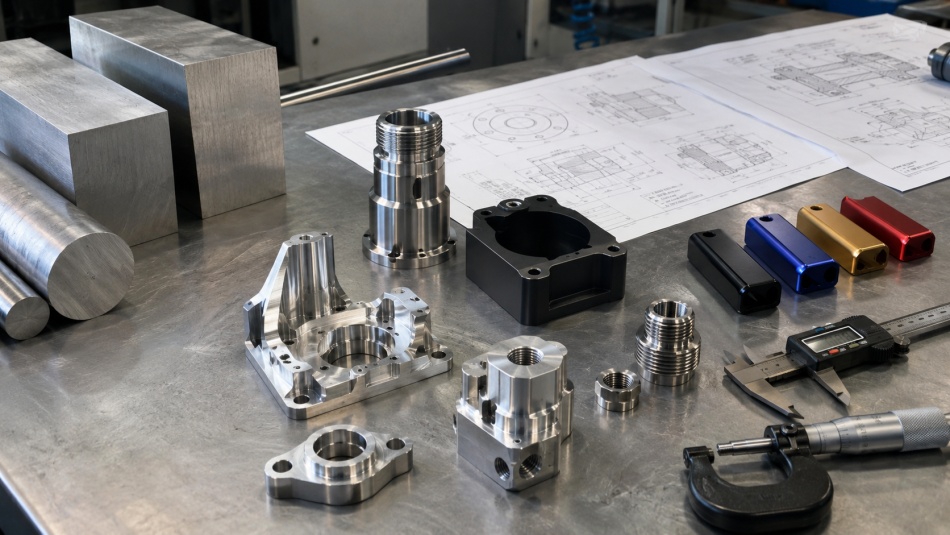
Two parts can have the same size and material but still have very different machining costs.
Even if both parts use a similar amount of aluminum, Part B will usually cost much more.
The difference is mainly machining time and manufacturing difficulty.
How Engineers Can Reduce CNC Machining Cost
When designing CNC-machined parts, consider these practical guidelines:
- Use standard and easily machined materials where possible.
- Avoid unnecessarily tight tolerances.
- Use larger internal corner radii.
- Avoid deep and narrow pockets when possible.
- Keep wall thickness reasonable.
- Reduce unnecessary setups and machining directions.
- Use standard holes and thread sizes.
- Avoid difficult-to-reach features.
- Specify fine surface finishes only where necessary.
- Discuss difficult features with your CNC supplier before finalizing the design.
Simple rule: CNC machining cost is usually driven more by machining time and manufacturing difficulty than by part size alone.
Final Thoughts
CNC machining price is not determined only by part size or material weight.
The biggest cost drivers are often machining time, geometry complexity, tolerance, tool access, and number of setups.
A small design change can sometimes reduce machining difficulty significantly without changing the function of the part.
For engineers, thinking about manufacturability during the design stage can help reduce cost, improve production stability, and shorten lead time.
Want to Reduce CNC Machining Cost Before Production?
CNCTAL manufactures custom CNC machined parts for prototypes, low-volume production, and repeat production.
If you have a STEP file and drawing, our engineering team can review the design and identify features that may increase machining cost before production.
Request a CNC Machining Quote