
CNC Machining MOQ Explained: What Buyers Need to Know
When sourcing custom CNC machined parts, one of the first questions buyers often ask is:
What is the minimum order quantity for CNC machining?
The simple answer is that CNC machining usually has much more flexible MOQ requirements than processes such as injection molding, die casting, or stamping.
Many CNC machine shops can produce anything from a single prototype to hundreds or thousands of production parts.
However, “no MOQ” does not mean the unit price will be the same at every quantity.
What Does MOQ Mean in CNC Machining?
MOQ means Minimum Order Quantity.
It is the smallest quantity a supplier is willing to manufacture or accept for an order.
For some manufacturing processes, MOQ can be high because expensive tooling must be made before production begins.
CNC machining is different.
A CNC machine can often start production directly from:
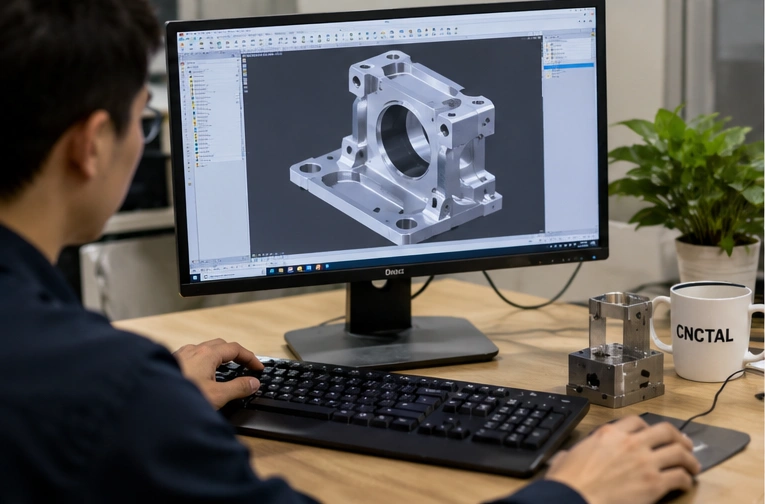
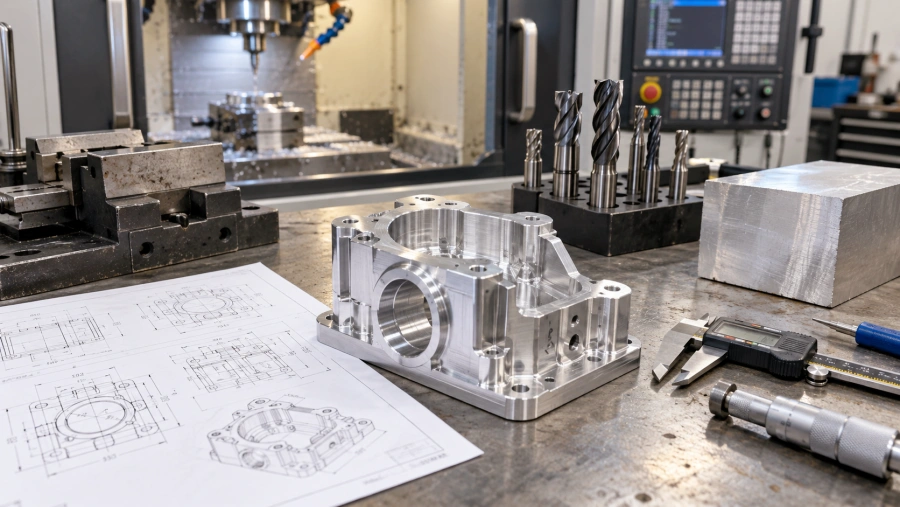
- A STEP file
- A 2D engineering drawing
- A CNC program
- Standard raw material
Because dedicated production tooling is often not required, CNC machining is suitable for very small quantities.
Does CNC Machining Have a Minimum Order Quantity?
Not always.
Many CNC machining suppliers accept orders starting from one piece.
This is one reason CNC machining is widely used for:
- Prototypes
- Engineering samples
- Product development
- Replacement parts
- Low-volume production
- Custom equipment parts
At CNCTAL, custom CNC machining projects can be produced without a fixed minimum quantity, from prototypes to production batches.
Why Is One CNC Part So Expensive?
This is one of the most common questions from buyers.
A single CNC part may have a high unit price because the supplier still needs to complete many of the same preparation steps required for a larger order.
These can include:
- Reviewing drawings
- CAM programming
- Preparing raw material
- Machine setup
- Tool preparation
- Workholding setup
- First-piece inspection
- Deburring and cleaning
- Packaging
If only one part is ordered, all setup and programming cost is included in one piece.
If 100 parts are ordered, the same setup cost can be spread across the entire batch.
CNC Machining MOQ vs. Economic Order Quantity
For buyers, it is useful to separate two different ideas.
For example:
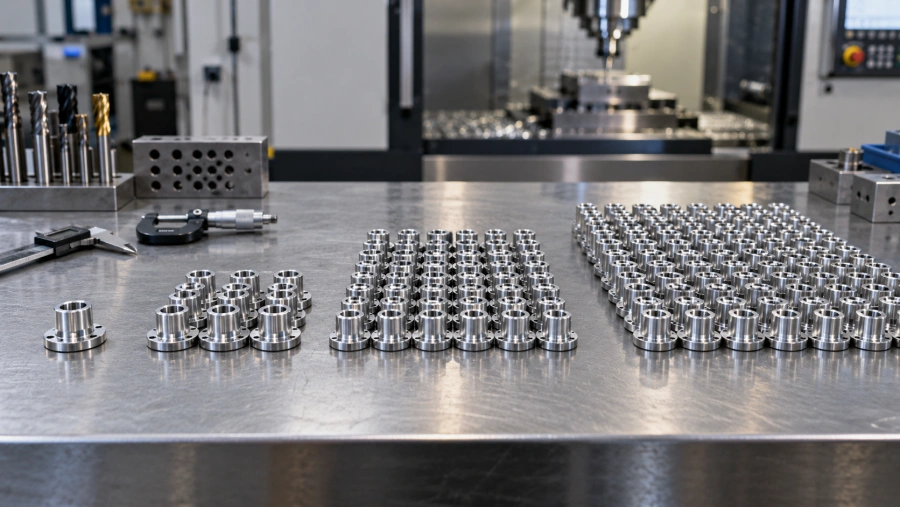
- 1 pc may be possible
- 5 pcs may be cheaper per unit
- 50 pcs may be much more economical
- 500 pcs may allow further process optimization
The exact price difference depends on the part.
Typical CNC Machining Order Quantities
There is no universal standard, but CNC machining projects can generally be divided into several groups.
| Order Type | Typical Quantity | Common Purpose |
|---|---|---|
| Prototype | 1–5 pcs | Design verification and testing |
| Engineering Sample | 5–20 pcs | Assembly and functional testing |
| Low-Volume Production | 20–500 pcs | Pilot runs and specialized equipment |
| Production | 500+ pcs | Repeat or larger-volume manufacturing |
These ranges are only general references.
The best quantity depends on part complexity, material, machining time, and annual demand.
Can I Order Just One CNC Prototype?
Yes.
CNC machining is one of the most suitable manufacturing processes for producing one-off prototypes.
A buyer can usually provide a 3D model and drawing and request one or several parts for testing.
This is useful when you need to check:
- Dimensions
- Assembly
- Function
- Material choice
- Surface finish
- Design changes
After the prototype is approved, the same design can move into low-volume or production quantities.
What Quantity Should Buyers Request in an RFQ?
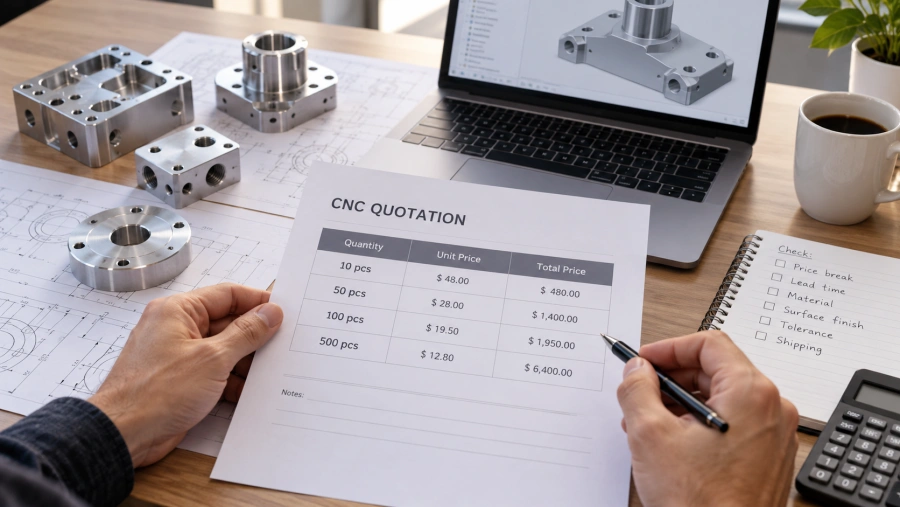
If you are not sure about the final order quantity, it is often better to request several quantity levels.
For example:
- 10 pcs
- 50 pcs
- 100 pcs
- 500 pcs
This allows you to compare how the unit price changes with volume.
It also helps the supplier understand whether the project is:
- A one-time prototype
- A low-volume project
- A potential repeat production order
Why Does Unit Price Drop at Higher Quantities?
Setup Cost Is Spread Across More Parts
Programming and setup costs are shared across the entire batch.
Material Purchasing Can Improve
Larger quantities may allow the supplier to purchase full bars, plates, or larger material batches more efficiently.
Machining Process Can Be Optimized
For repeat production, the supplier may improve:
- Fixtures
- Toolpaths
- Tool selection
- Inspection methods
Fewer Interruptions
Producing 100 identical parts in one batch is usually more efficient than making the same 100 parts across many small orders.
Does Higher Quantity Always Mean a Much Lower Price?
No.
Some CNC machining costs remain almost the same for every part.
These include:
- Raw material
- Machine cycle time
- Tool wear
- Surface treatment
- Inspection
- Packaging
For example, if one titanium component requires two hours of 5-axis machining, producing 100 pieces still requires significant machine time.
Higher quantity helps reduce setup cost, but it does not remove the actual machining cost.
How Part Complexity Affects MOQ and Pricing
A supplier may technically accept one piece, but very complex parts can still have high minimum order values.
Examples include parts with:
- Multiple setups
- 5-axis machining
- Very tight tolerances
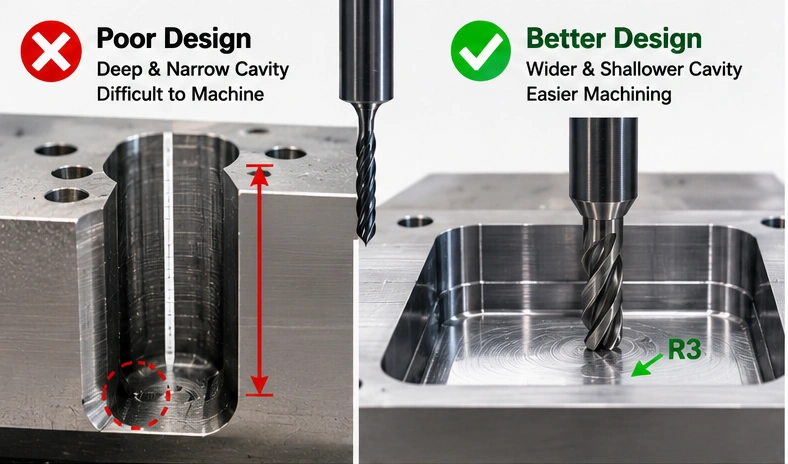
- Deep pockets
- Thin walls
- Special tooling
- Complex inspection
- Multiple surface treatments
Buyers should look at both MOQ and total order value, not MOQ alone.
Prototype MOQ vs. Production MOQ
Is CNC Machining Suitable for Low-Volume Production?
Yes.
Low-volume production is one of the strongest applications for CNC machining.
It is especially useful when:
- Injection molding tooling is too expensive
- Product demand is uncertain
- The design may still change
- Annual quantities are limited
- High precision is required
- Multiple product versions are needed
This makes CNC machining attractive for industries such as:
- Automation
- Robotics
- Medical equipment
- Laboratory equipment
- Aerospace
- Packaging machinery
- Industrial equipment
- Precision instruments
When Does Another Manufacturing Process Become Better?
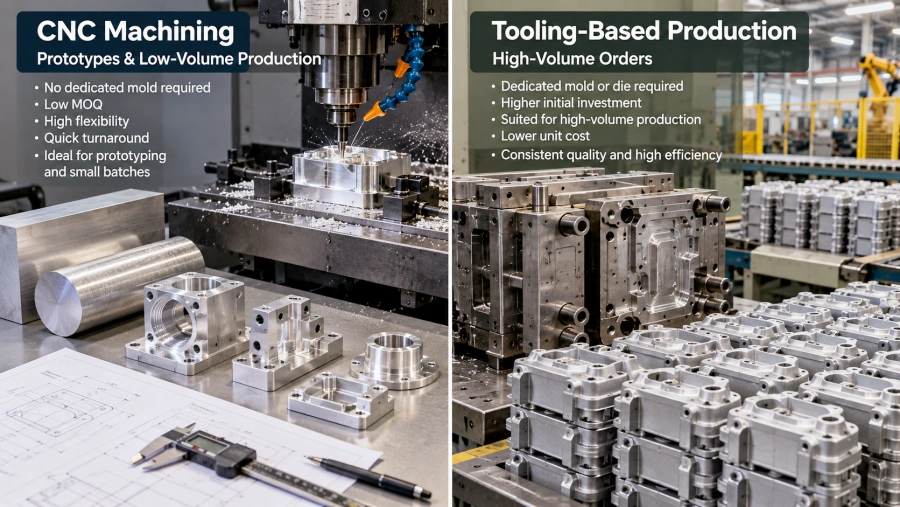
CNC machining is highly flexible, but it may not always be the lowest-cost process at very high volumes.
For thousands or millions of identical parts, processes such as:
- Die casting
- Injection molding
- Stamping
- Forging
- Extrusion
may eventually offer a lower unit cost.
However, these processes normally require higher tooling investment and larger order quantities.
What Should Buyers Send for a CNC Quote?
To receive an accurate quotation, provide as much useful information as possible.
A good CNC RFQ should include:
- 3D CAD file, preferably STEP.
- 2D drawing with important tolerances.
- Material specification.
- Quantity or several quantity levels.
- Surface finish requirements.
- Required delivery date.
- Shipping destination if freight is required.
If annual demand is known, include that information as well.
Example:
Initial order: 50 pcs
Expected annual demand: 500–1,000 pcs
This helps the supplier evaluate the project more accurately.
Should Buyers Choose a Supplier Only Based on MOQ?
Usually not.
A low MOQ is useful, but purchasing teams should also consider:
- Machining capability
- Quality control
- Material traceability
- Communication
- Lead time
- Surface finishing capability
- Repeat-order consistency
- Shipping options
- Total landed cost
A supplier willing to make one piece is not necessarily the best supplier for a future 5,000-piece production order.
Common Questions About CNC Machining MOQ
Can I order only 1 CNC machined part?
Yes. Many CNC suppliers accept one-piece prototype orders.
Why is the unit price high for 1–5 pieces?
Because programming, setup, tooling preparation, and inspection costs are spread across very few parts.
Does CNC machining require tooling fees?
Usually there is no dedicated mold or die cost, but setup, programming, fixtures, or special tooling may still be included in the quotation.
Will 100 pieces cost less per part than 10 pieces?
Usually yes, because setup and production can be spread across a larger batch.
Can I request multiple quantity prices?
Yes. Buyers are often better served by asking for several quantities, such as 10, 50, 100, and 500 pieces.
Final Thoughts
CNC machining does not always require a high minimum order quantity.
In many cases, a supplier can produce just one prototype and later scale the same project into low-volume or production quantities.
However, buyers should remember that MOQ and unit price are not the same thing.
Very small quantities are possible, but setup, programming, and inspection costs make the unit price higher.
For purchasing teams, the best approach is to provide clear drawings and request pricing at several quantity levels.
This makes it easier to understand the real cost difference between prototype, low-volume, and production orders.
Need a CNC Quote With Flexible Quantities?
CNCTAL supports custom CNC machining from 1 piece to production quantities, including prototypes, low-volume parts, and repeat manufacturing.
Send us your STEP file, drawing, material, and required quantities, and our team can provide a quotation based on your actual project requirements.
Request a CNC Machining Quote