
How to Prepare a CNC Machining RFQ: Drawings, Materials, Quantities and Key Details
When contacting a CNC machining supplier, the quality of your quotation depends heavily on the information you provide.
A complete RFQ helps the supplier understand the part, choose the right machining process, estimate machining time, calculate material cost, and provide a more accurate lead time.
For overseas buyers and engineers sourcing CNC machined parts from China, a clear RFQ also reduces unnecessary emails and technical misunderstandings.
What Is a CNC Machining RFQ?
RFQ means Request for Quotation.
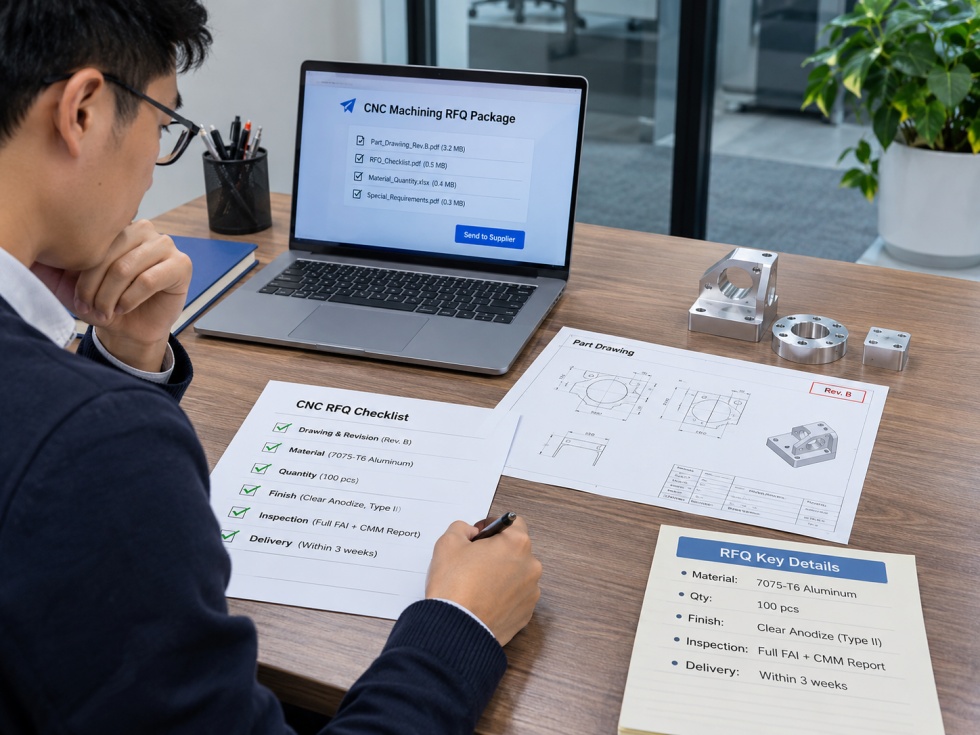
A CNC machining RFQ is the package of technical and commercial information you send to a supplier when asking for a price.
A good RFQ usually contains:
- 3D CAD file
- 2D drawing
- Material
- Quantity
- Surface finish
- Important tolerances
- Inspection requirements
- Delivery destination
The more complete the information, the easier it is for the supplier to prepare an accurate quotation.
1. Provide a 3D CAD File
For most CNC machined parts, a 3D model is the most useful starting point.
The preferred formats are usually:
- STEP
- STP
- IGES / IGS
STEP files are especially useful because they allow the supplier to review the full geometry and prepare CAM programming.
The 3D model helps the machinist understand:
- Overall shape
- Pockets
- Holes
- Internal features
- Wall thickness
- Machining directions
- Tool access
For complex parts, a screenshot or PDF alone is usually not enough for accurate quoting.
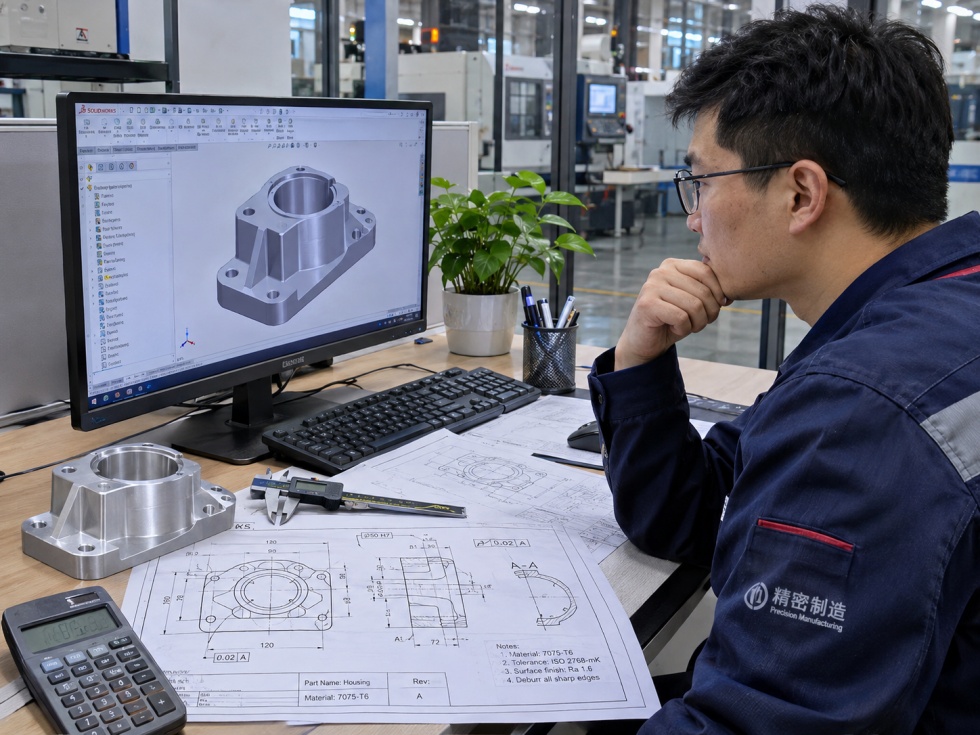
2. Include a 2D Engineering Drawing
A 3D model shows geometry, but it does not always show all manufacturing requirements.
A 2D drawing should be included when the part has:
- Tight tolerances
- Threads
- Fits
- GD&T
- Surface finish requirements
- Critical dimensions
- Special notes
The drawing helps the supplier understand which dimensions are important.
For example, the STEP model may show a 10 mm hole, while the drawing specifies Ø10 H7. That requirement can change both machining and inspection.
3. Make Sure the 3D Model and Drawing Match
The STEP file and PDF drawing should represent the same revision.
Before sending the RFQ, check:
- Part number
- Revision number
- Overall dimensions
- Hole positions
- Threads
- Design changes
If the 3D model and drawing are different, the supplier may quote the wrong design.
A simple file naming system can help:
Part-001_REV-B.step
Part-001_REV-B.pdf
4. Specify the Material Clearly
Do not write only “Aluminum” or “Steel.”
Different material grades can have very different prices and machining properties.
Examples include:
- Aluminum 6061-T6
- Aluminum 7075-T6
- Aluminum 6082-T6
- Stainless Steel 304
- Stainless Steel 316L
- 42CrMo4
- C45
- Brass C360
- POM-C
- PEEK
If an equivalent material is acceptable, state this clearly.
5. Provide the Required Quantity
Quantity has a major effect on CNC machining price.
The supplier needs to know whether the project is:
- One prototype
- 10 samples
- 100 low-volume parts
- 1,000 production parts
Do not simply ask:
“How much does this part cost?”
Instead, provide the actual quantity.
6. Ask for Multiple Quantity Price Breaks When Needed
If you are not sure about the final order volume, ask for several quantity levels.
For example:
- 10 pcs
- 50 pcs
- 100 pcs
- 500 pcs
This helps you understand how the unit price changes as production volume increases.
For repeat projects, also provide annual demand. For example: Initial order: 100 pcs / Estimated annual demand: 1,000 pcs.
7. Specify Surface Finish
If the part requires a surface finish, include it in the RFQ.
Common requirements include:
- As machined
- Bead blasted
- Anodized
- Hard anodized
- Powder coated
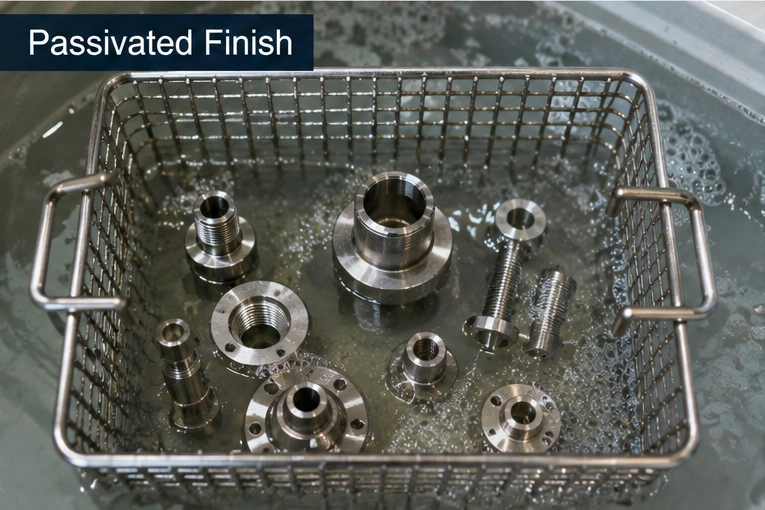
- Passivated
- Black oxide
- Zinc plated
- Nickel plated
- Polished
For anodized aluminum, also specify the color when needed.
For example:
Finish: Type II anodizing, black
8. Identify Critical Tolerances
Not every dimension needs a very tight tolerance.
If possible, clearly identify the features that are functionally important.
Examples include:
- Bearing bores
- Shaft diameters
- Press-fit holes
- Sealing surfaces
- Mating faces
- Hole position
- Flatness
This helps the supplier understand where additional machining and inspection effort is required.
9. Include Thread Information
Threads should be clearly defined.
Examples:
- M3 × 0.5
- M6 × 1.0
- 1/4-20 UNC
- 1/8 NPT
Also indicate whether the thread is through, blind, or has a specified thread depth.
10. Define Surface Roughness If It Matters
Most CNC parts do not need extremely fine surface roughness on every surface.
If a specific surface requires a roughness value, mark it clearly.
For example:
- Ra 3.2 µm
- Ra 1.6 µm
- Ra 0.8 µm
Fine surface requirements may require additional finishing passes or grinding.
11. Mention Heat Treatment
If the part requires heat treatment, include it in the RFQ.
Examples include:
- Hardened and tempered
- Vacuum heat treatment
- Induction hardening
- Stress relief
- Solution treatment
- Aging
If hardness is required, provide the target range.
For example:
Heat treatment: 32–36 HRC
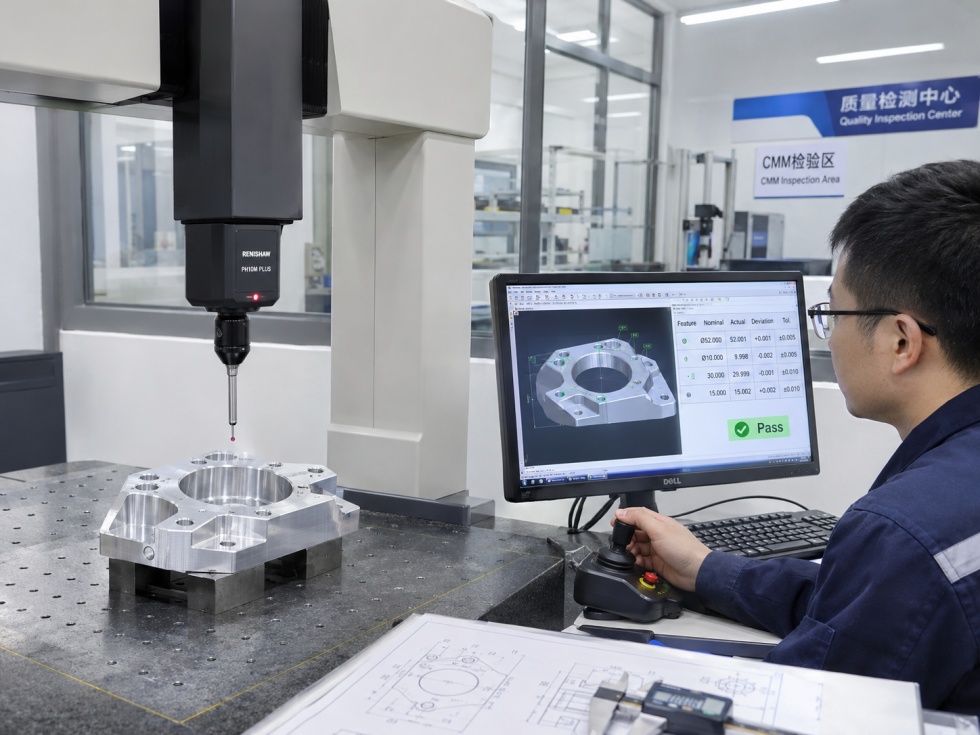
12. Explain Inspection Requirements
For standard CNC parts, normal dimensional inspection may be sufficient.
For critical parts, you may require:
- CMM inspection
- First Article Inspection
- Full dimensional report
- Material certificate
- Surface roughness report
- 100% inspection of critical features
If you need these documents, include them in the RFQ.
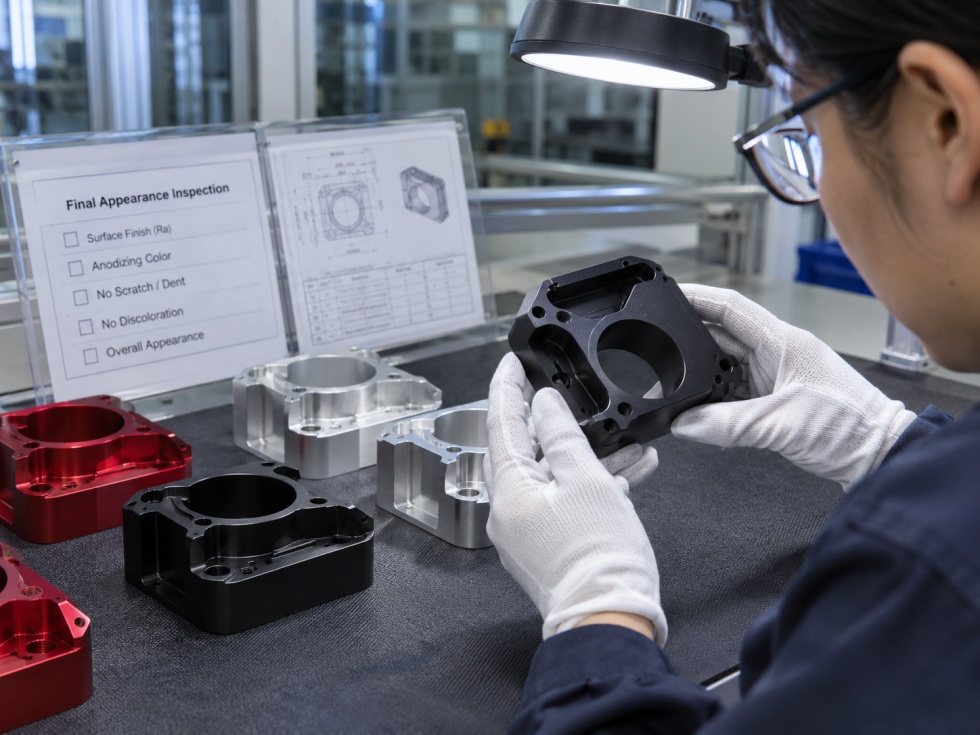
13. Specify Cosmetic Requirements
If the part is visible to the end customer, appearance may be important.
You may need to specify:
- No visible scratches
- Consistent anodizing color
- No dents
- No machining marks on cosmetic surfaces
- Protected visible surfaces
Mark cosmetic surfaces clearly on the drawing if possible.
14. Provide Assembly Information When Relevant
Sometimes one part cannot be evaluated correctly without understanding how it is used.
Useful information may include:
- Mating component
- Bearing fit
- Press-fit requirement
- Sliding fit
- Sealing surface
- Assembly orientation
You do not always need to send the entire product design.
But explaining the function of a critical feature can help the supplier understand why a tolerance matters.
15. Tell the Supplier About Special Risks
If you already know that the part has a difficult feature, mention it.
Examples include:
- Thin walls
- Deep pockets
- Long shafts
- Large flat plates
- Very small holes
- Long plastic parts
- Tight flatness
- Deep internal threads
This gives the supplier an opportunity to review manufacturability before quoting.
16. Provide the Delivery Destination
If you want the supplier to quote shipping, include the destination.
At minimum, provide:
- City
- Postal code
- Country
For example:
Delivery: Dallas, TX 75201, USA
17. State the Required Delivery Date
If your project has a deadline, include it.
For example:
Required delivery: December 15
Remember that total delivery time may include:
- Material preparation
- Machining
- Surface finishing
- Inspection
- Packaging
- International shipping
18. Specify the Incoterm If You Have a Preference
For international orders, common Incoterms include:
- EXW
- FCA
- FOB
- DAP
- DDP
Providing the preferred shipping term makes quotations easier to compare.
19. Tell the Supplier Whether the Project Will Repeat
Repeat production can affect how the supplier prepares the quotation.
For example:
First order: 100 pcs
Repeat orders: Expected every 3 months
The supplier may consider dedicated fixtures, material purchasing, tooling strategy, stored CNC programs, and repeat inspection plans.
20. Avoid Sending Unnecessary Information
A complete RFQ does not mean sending hundreds of unrelated files.
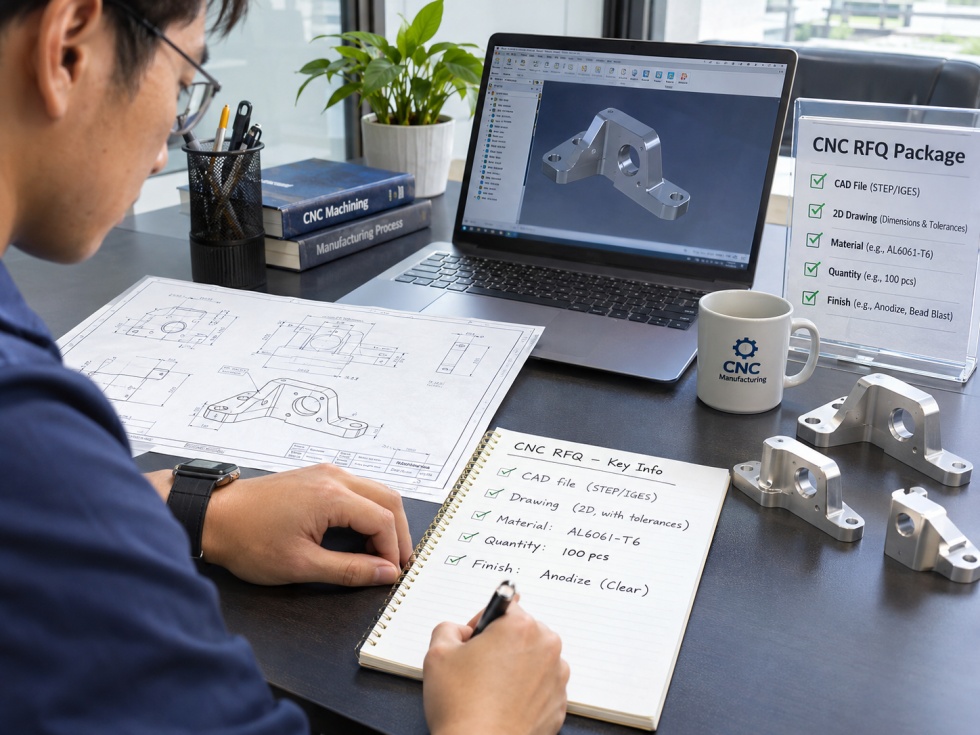
For most CNC projects, the essential package is simple:
- STEP file
- PDF drawing
- Material
- Quantity
- Finish
- Delivery destination
- Special requirements
A clear five-line email with the correct files is often better than a long email with unclear instructions.
A Simple CNC Machining RFQ Example
Part: Aluminum Mounting Bracket
Material: Aluminum 6061-T6
Quantity: 10 / 50 / 100 pcs
Finish: Black anodizing, Type II
Tolerance: Per attached drawing
Inspection: Standard inspection, material certificate required
Delivery: Chicago, IL, USA
Files: STEP + PDF drawing attached
Please provide:
- Unit price for each quantity
- Tooling or setup cost if applicable
- Production lead time
- Shipping cost
- DFM comments if any
Common RFQ Mistakes
Sending Only a Photo
A photo may help explain the product, but it is usually not enough for accurate CNC pricing.
Sending Only an STL File
STL files can be useful for visual reference, but STEP is generally better for CNC manufacturing because it contains solid geometry.
Missing Material
Different materials can create large price differences.
Missing Quantity
A supplier cannot prepare realistic unit pricing without knowing the order quantity.
No Drawing for Tight-Tolerance Parts
If the part has important fits or GD&T requirements, a STEP file alone may not be enough.
Asking for a Quote Before the Design Is Final
If the design changes significantly after quotation, the price may also need to change.
Using Different Revisions
A supplier may quote one revision while the buyer expects another.
What Information Is Most Important?
If you want a fast quotation, prioritize these six items:
What Makes a Good CNC RFQ?
A good RFQ is not necessarily long.
It is:
- Clear
- Complete
- Consistent
- Easy to understand
The goal is to remove assumptions.
If the supplier has to guess the material, tolerance, finish, or quantity, the quotation becomes less reliable.
Final Thoughts
Preparing a good CNC machining RFQ can save time for both the buyer and the supplier.
The most important information is usually:
- Correct CAD file
- Correct drawing revision
- Exact material
- Required quantity
- Surface finish
- Critical tolerances
- Inspection requirements
- Delivery destination
For overseas buyers working with Chinese CNC factories, clear RFQ information is especially important because it reduces technical misunderstandings and unnecessary communication across time zones.
A good CNC supplier should also review the files and ask questions when something is unclear.
Ready to Send Your CNC Machining RFQ?
CNCTAL in Dongguan reviews STEP files and engineering drawings before quotation and can provide feedback on material, tolerances, machining difficulty, surface finishing, and production quantities.
Send us your STEP file, PDF drawing, material, quantity, and finishing requirements to receive a CNC machining quotation.
Request a CNC Machining Quote