
3-Axis vs. 5-Axis CNC Machining: What’s the Difference?
CNC machining can produce everything from simple mounting plates to complex aerospace and robotic components. However, not every part needs the same type of machine.
Two of the most common options are 3-axis CNC machining and 5-axis CNC machining.
The main difference is the number of directions in which the cutting tool and workpiece can move relative to each other. That difference affects the types of geometry that can be machined, the number of setups required, production cost, and sometimes the achievable accuracy between features.
What Is 3-Axis CNC Machining?
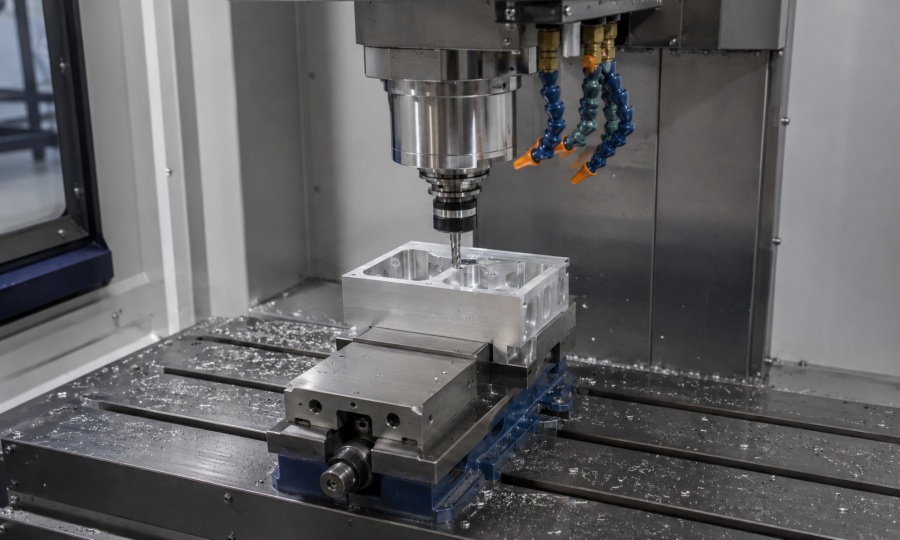
A 3-axis CNC milling machine moves along three linear axes:
- X-axis: left and right
- Y-axis: forward and backward
- Z-axis: up and down
During machining, the workpiece is normally fixed on the machine table while the cutting tool moves along these three directions.
This is the most common type of CNC milling and is suitable for a large percentage of everyday machined components.
Typical 3-axis parts include:
- Mounting plates
- Brackets
- Machine bases
- Simple aluminum housings
- Heat sinks
- Fixtures
- Covers
- Flat panels
- Simple manifolds
- Components with pockets and drilled holes
If most features can be accessed from the top or from a few straightforward orientations, 3-axis machining is often the most economical choice.
What Is 5-Axis CNC Machining?
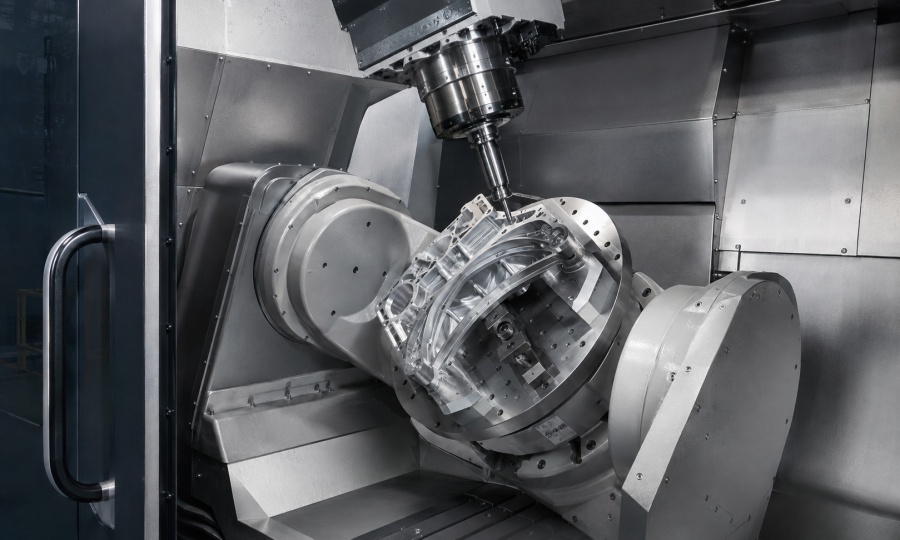
A 5-axis CNC machine adds two rotational axes to the three linear X, Y and Z axes.
These additional movements allow the cutting tool to approach the workpiece from different angles without manually repositioning the part after every operation.
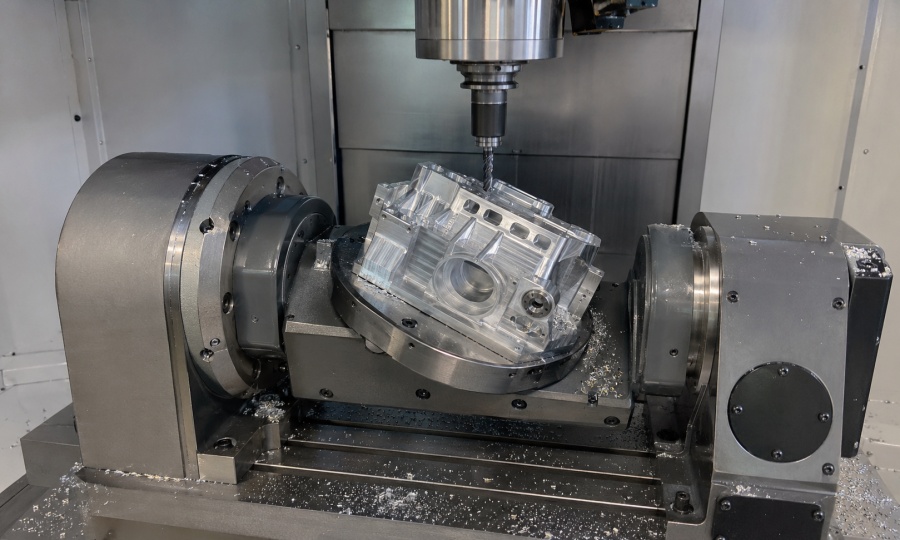
Depending on the machine design, the table may rotate and tilt, the spindle head may rotate, or the machine may use a combination of both.
This makes 5-axis machining useful for parts containing:
- Angled surfaces
- Features on several sides
- Complex contours
- Deep cavities
- Compound angles
- Difficult-to-reach holes
- Curved surfaces
Typical applications include aerospace components, impellers, medical parts, robotic components, precision instruments and complex mechanical housings.
The Main Difference Between 3-Axis and 5-Axis Machining
The basic difference is not simply that a 5-axis machine has two more axes.
The important difference is how easily the cutting tool can reach different areas of the part.
| 3-Axis CNC Machining | 5-Axis CNC Machining |
|---|---|
| X, Y and Z linear movement | X, Y and Z plus two rotary axes |
| Best for simpler geometry | Better for complex geometry |
| May require several setups for multiple sides | Can machine several sides in fewer setups |
| Programming is generally simpler | Programming and simulation are more complex |
| Usually lower cost for simple parts | Higher machine and programming cost |
| Excellent for plates, brackets and simple housings | Useful for angled, curved and multi-face parts |
A 5-axis machine is not automatically the better choice. For a simple component, a well-planned 3-axis process can often produce the same result faster and at a lower cost.
3-Axis CNC Machining Capabilities
Modern 3-axis machining centers are more capable than they sometimes appear.
They can perform operations such as:
- Face milling
- Pocket milling
- Drilling
- Reaming
- Tapping
- Boring
- Contour milling
- Thread milling
- Chamfering
For many industrial components, these operations are all that is required.
A component can also be repositioned between operations. For example, after machining the top face, the operator can rotate the part and machine another side.
This means a 3-axis machine can still manufacture parts with features on several faces.
The trade-off is that every additional setup requires more time and creates another opportunity for positioning error.
5-Axis CNC Machining Capabilities
The biggest advantage of 5-axis machining is accessibility.
The machine can orient the workpiece or cutting tool so that difficult features can be reached from more useful cutting angles.
This can allow several surfaces to be machined in a single setup.
For example, a complex housing may require machining on the top, front, left and right sides.
On a 3-axis machine, this might require several setups and different fixtures.
On a 5-axis machine, many of these features may be machined without removing the workpiece from the original fixture.
3+2 Machining vs. Simultaneous 5-Axis Machining
Not all 5-axis machining works in the same way.
Two common methods are 3+2 machining and simultaneous 5-axis machining.
3+2 Axis Machining
With 3+2 machining, the rotary axes first position the workpiece at a required angle.
The rotary axes then remain stationary while the machine performs a conventional 3-axis cutting operation.
After that operation is completed, the machine can rotate to another position and continue machining.
This method is very useful for:
- Angled holes
- Multiple-side machining
- Fixtures
- Housings
- Components with several angled faces
Simultaneous 5-Axis Machining
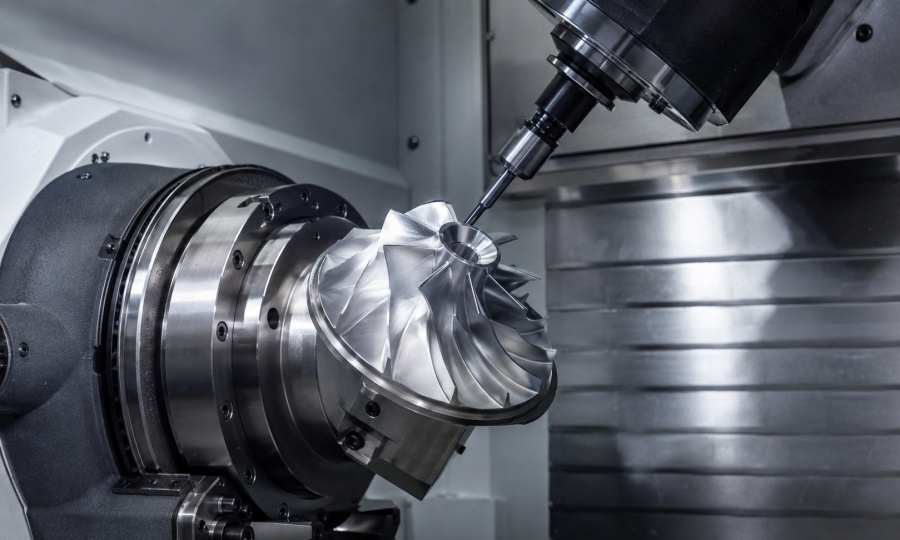
In simultaneous 5-axis machining, all five axes can move together while the cutting tool is engaged with the material.
This allows the tool orientation to continuously change along the cutting path.
It is particularly useful for complex curved surfaces such as:
- Impellers
- Turbine components
- Aerospace surfaces
- Medical implants
- Complex mold surfaces
However, simultaneous 5-axis machining requires more advanced programming, toolpath simulation and machine control.
Which Process Is More Accurate?
It is common to hear that 5-axis machining is automatically more accurate than 3-axis machining.
That is not quite correct.
A high-quality 3-axis machine can produce extremely accurate components.
Machining accuracy depends on many factors, including:
- Machine condition
- Machine rigidity
- Spindle accuracy
- Tool condition
- Workholding
- Material stability
- Cutting parameters
- Temperature
- Programming
- Inspection methods
The real accuracy advantage of 5-axis machining often comes from reducing the number of setups.
Every time a part is removed, rotated and re-clamped, a small positioning error can be introduced.
If several critical features can be machined in one setup, their positional relationship can often be controlled more consistently.
Complexity and Programming
3-axis programming is generally more straightforward.
For relatively simple parts, CAM programming is faster, toolpaths are easier to verify, and collision risks are easier to manage.
5-axis programming requires more planning.
The programmer must consider:
- Tool orientation
- Rotary-axis movement
- Tool holder clearance
- Fixture clearance
- Machine travel limits
- Possible collisions
- Machine kinematics
Simulation becomes especially important because the spindle, tool holder, table and workpiece can all move relative to each other.
This additional programming work is one reason why 5-axis machining may cost more, particularly for prototypes and very small production quantities.
Advantages of 3-Axis CNC Machining
Lower Cost for Simple Parts
When the geometry is straightforward, 3-axis machining usually provides the most cost-effective solution.
There is little reason to use an expensive 5-axis process for a simple rectangular plate with holes and pockets.
Simple Programming and Setup
Toolpaths and fixtures are generally easier to prepare, which can reduce engineering and setup time.
Wide Availability
3-axis machining centers are widely used throughout the CNC machining industry, making them suitable for prototypes as well as volume production.
Good Accuracy
With proper tooling, workholding and process control, 3-axis machines can hold tight tolerances for many precision components.
Advantages of 5-Axis CNC Machining
Fewer Setups
This is often the most important benefit.
Reducing setups saves handling time and can improve consistency between features.
Better Access to Complex Features
The cutting tool can approach the component from different angles, making it easier to machine angled holes, side features and complex surfaces.
Shorter Cutting Tools
Tilting the workpiece or spindle can sometimes allow a shorter tool to reach a deep feature.
Shorter tools are generally more rigid and less prone to vibration than long tools.
This can improve surface finish and machining stability.
Complex Geometry
Some geometries are extremely difficult, inefficient or even impossible to produce economically with conventional 3-axis machining.
Five-axis machines greatly expand the range of machinable shapes.
When Should You Use 3-Axis Machining?
3-axis machining should usually be considered first when the component has relatively simple geometry.
Good candidates include:
- Flat plates
- Simple brackets
- Rectangular housings
- Components with top-side pockets
- Basic drilling patterns
- Simple fixtures
- Parts where several setups are acceptable
For these components, 3-axis machining often provides excellent quality without unnecessary machine or programming costs.
When Does 5-Axis Machining Make Sense?
Five-axis machining becomes more valuable when the design includes several difficult orientations or complex surfaces.
Typical examples include:
- Features located on several sides
- Angled holes
- Compound angles
- Deep pockets with difficult tool access
- Complex curved surfaces
- Tight positional relationships between different faces
- Parts that would otherwise require many fixtures
The important question is not: “Can this part be machined on a 3-axis machine?”
In many cases, the answer is yes.
A better question is: “Which machining method produces the part most efficiently and consistently?”
Is 5-Axis Machining Always More Expensive?
Not necessarily.
The hourly machine rate for 5-axis machining is normally higher, and programming can also take longer.
However, total part cost depends on the complete manufacturing process.
Consider a component that requires:
- Four separate 3-axis setups
- Several fixtures
- Repeated alignment
- Additional inspection between operations
If the same component can be produced in one or two 5-axis setups, the higher machine rate may be offset by reduced setup and handling time.
For complex components or larger production quantities, 5-axis machining can sometimes be more economical overall.
For simple parts, however, 3-axis machining will usually remain the better choice.
Part Design Considerations
Choosing between 3-axis and 5-axis machining should ideally happen during the design stage rather than after the drawing is complete.
Check Tool Access
Ask whether a cutting tool can physically reach each feature.
Deep pockets, angled holes and hidden surfaces can quickly make a simple-looking component difficult to machine.
Avoid Unnecessary Complexity
Adding angled surfaces or unusual features without a functional reason can increase manufacturing cost.
If a feature can be designed so that it is accessible from a standard machining direction, 3-axis manufacturing may become possible.
Consider the Number of Setups
Features located on many different faces may require several re-clamping operations.
If those features also have tight positional relationships, 5-axis machining may be useful.
Apply Tight Tolerances Only Where Needed
Whether the part is produced on a 3-axis or 5-axis machine, unnecessary tight tolerances increase machining and inspection costs.
Critical tolerances should be clearly identified on the 2D drawing.
3-Axis or 5-Axis: Which Should You Choose?
There is no reason to specify 5-axis machining just because a component appears complex.
In many cases, the manufacturer can decide the most efficient process after reviewing the design.
Simple geometry with easily accessible features → 3-axis machining
Complex geometry, angled features or multiple critical faces → consider 5-axis machining
A good CNC supplier may even use a combination of processes.
For example, the main geometry could be completed on a 3-axis machine, while a difficult secondary operation is completed using a 5-axis machining center.
The manufacturing method should serve the design—not the other way around.
Final Thoughts
Both 3-axis and 5-axis CNC machining are important manufacturing methods.
Three-axis machining remains the practical and economical choice for a large number of precision components. It is efficient, accurate and widely available.
Five-axis machining becomes valuable when the component has complex geometry, difficult tool access, multiple critical faces, or would otherwise require repeated setups.
The biggest advantage of 5-axis machining is not simply that the machine can move in more directions. It is the ability to manufacture complex features with better access and fewer setups.
If you are deciding how to manufacture a new component, a STEP file together with a properly dimensioned 2D drawing gives the machining supplier the information needed to evaluate whether 3-axis, 3+2-axis or simultaneous 5-axis machining is the most practical solution.